

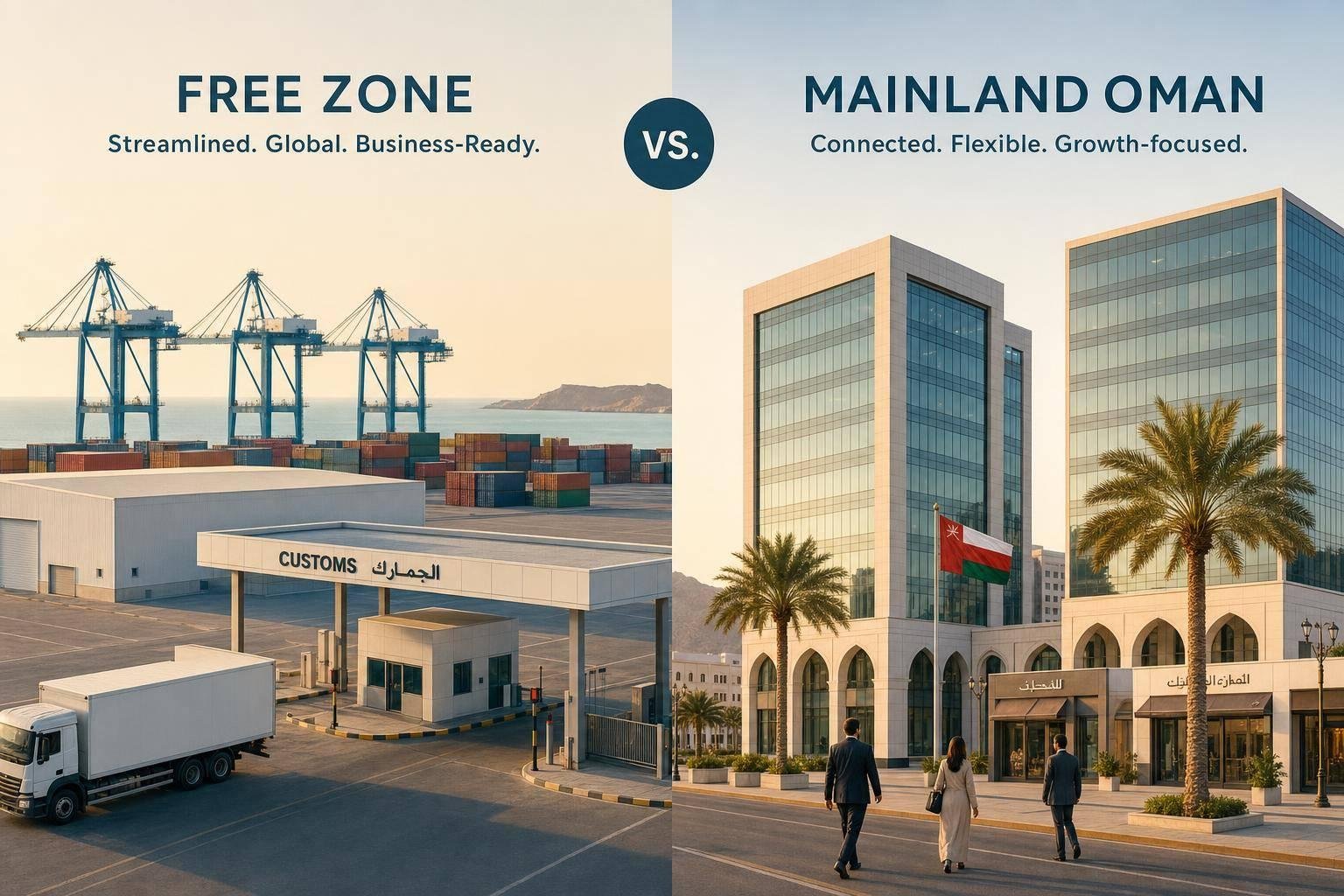
If I plan to sell inside Oman, I’d usually pick mainland. If I plan to export, re-export, or manufacture for overseas markets, I’d usually pick a free zone. That is the short answer.
Here’s what matters most:
- Market access: mainland lets me sell across Oman and bid for government work
- Tax: mainland usually pays 15% corporate tax and 5% VAT; free zones may get 0% corporate tax for up to 30 years
- Customs: free zones usually pay 0% on imports and re-exports inside the zone, but goods entering mainland Oman often face 5% customs duty plus 5% VAT
- Ownership: both routes can allow 100% foreign ownership in many cases
- Visas and staffing: mainland often has tighter Omanisation and admin rules; free zones may have lower early-stage Omanisation targets
- Office rules: mainland needs local premises; free zones usually need space inside the zone before visas and licensing move ahead
- Best fit: mainland suits local trading, local services, and government-linked work; free zones suit logistics, manufacturing, storage, and export-led models
So if I’m choosing between the two, I’d start with one question: where will my customers be? If most revenue is from Oman, mainland often fits better. If most revenue is from outside Oman, a free zone often fits better.
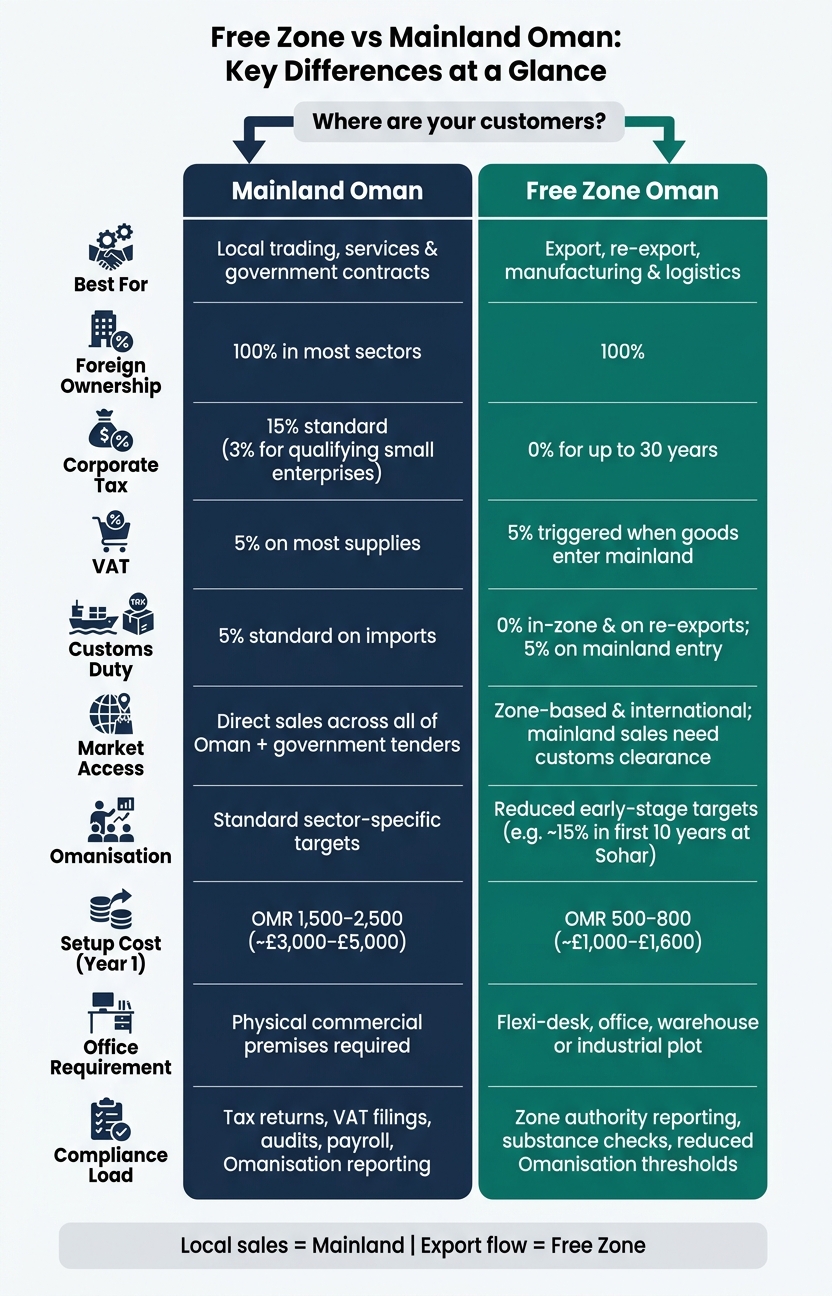
Free Zone vs Mainland Oman: Key Differences at a Glance
Oman Mainland vs. Free Zone The Hidden Annual Costs You Must Know
sbb-itb-55910af
Quick Comparison
| Factor | Mainland Oman | Free Zone Oman |
|---|---|---|
| Main use | Selling and working inside Oman | Export, re-export, manufacturing, logistics |
| Local market access | Direct | Limited; mainland sales often need customs clearance |
| Foreign ownership | 100% in many sectors | 100% |
| Corporate tax | Usually 15% | May be 0% for up to 30 years |
| VAT | Usually 5% | Mainland movement can trigger 5% VAT |
| Customs | Usually 5% on imports | Usually 0% in-zone and on re-exports |
| Government tenders | Yes | Not usually the right route on its own |
| Omanisation | Higher | Often lower, especially early on |
| Typical fit | Trading, consulting, local contracts | Warehousing, industry, regional supply chains |
I’d use this as a simple rule: local sales = mainland; export flow = free zone.
Free Zone Oman: how it works and who it suits
Oman’s free zones now sit under one set of rules through Royal Decree 38/2025, with OPAZ as the regulator. That means places like Sohar Freezone, Salalah Free Zone, the Special Economic Zone at Duqm (SEZAD), and Al Mazunah Free Zone now follow one broad system for ownership, licensing, tax, and customs.
The big issue is simple: is your business built for zone-based trade, or does it need direct access to customers inside Oman? That’s where the free zone model either works in your favour or starts to box you in.
Ownership, permitted activities, and where you can operate
Free zones allow 100% foreign ownership, so you do not need a local partner. Most zones also do not set a minimum capital requirement. In many cases, you can register either as a locally incorporated zone company or as a branch of an existing foreign business, depending on how you want to handle liability and day-to-day operations.
Your permitted activity depends on the zone you choose. Each one has its own focus:
- Sohar: metals, petrochemicals, and logistics
- Salalah: logistics, light manufacturing, and assembly
- Duqm: large-scale industrial, maritime, logistics, and tourism projects
- Al Mazunah: cross-border trading and light industry
In plain terms, free zone licences are mainly built for activity inside the zone, exports, and regional trade. If you want to sell straight into mainland Oman, you will usually need extra approvals, a mainland entity, or a locally licensed distributor or agent.
Office space, visas, tax, and customs
You will usually need to lease premises inside the zone before the licence process can move ahead and before visas can be sponsored. The size of your office, warehouse, or unit often affects how many visas you can get and how much staff capacity you can support.
OPAZ also runs a one-stop shop for licensing, immigration, and utilities, so these steps sit within one framework rather than being split across different bodies.
Eligible companies can get an initial 10-year corporate income tax exemption, with two renewals that can take the total to 30 years. They also pay no customs duty on imports used inside the zone or on goods re-exported from it.
But there’s a catch, and it matters. Goods moved from a free zone into mainland Oman are treated as imports. That usually means 5% customs duty on the CIF value, plus 5% VAT on the amount after duty is added. So the model is strongest when your business is geared towards exports and regional flows, not local sales.
Omanisation is usually lower in free zones than on the mainland, but it still applies. It helps to build Omani hiring and training into your HR plan early. If you leave it too late, visa renewals and licence continuity can become a problem.
When a free zone fits: manufacturing, re-export, and regional operations
A free zone tends to work best when most of your income comes from outside Oman’s local market.
Take a manufacturer importing raw materials, processing them, and shipping finished products to buyers across the GCC, Africa, or Asia. That setup can bring materials in duty-free, use the tax holiday, and export goods without Omani customs applying. For that kind of business, the model fits neatly.
The same goes for a regional logistics or distribution company. It can receive bulk shipments, store stock, do light assembly or packaging, and then re-export through Oman. Sohar Freezone still draws logistics and industrial investment for exactly this reason.
A regional services hub can also make sense in a free zone. Think of an engineering design team or IT support centre serving clients across the Middle East and Africa. It can lease a modest office and operate without a mainland licence, as long as it is not trying to sell straight into the Omani retail or government market.
That last point is where many firms trip up. If a meaningful share of your contracts will come from local companies or public-sector buyers in Oman, a free zone on its own will not do the job.
If most of your customers are inside Oman, the mainland route is the one to compare against.
Mainland Oman: how it works and who it suits
If a free zone works best for export-led business, mainland Oman is the route for direct trading inside the country and day-to-day work with local clients. A company registered with the Ministry of Commerce, Industry and Investment Promotion (MOCIIP) can trade across Oman, sign local contracts, and bid for government work.
Ownership, licensing, and access to the domestic market
For most foreign investors, the usual setup is an LLC. It gives limited liability and, in most sectors, allows 100% foreign ownership under the Foreign Capital Investment Law (Royal Decree 50/2019). That said, a small group of activities is still reserved for Omani nationals. This includes some retail trades and certain transport services, so it makes sense to check the official activity list before you assume full ownership is allowed.
That freedom comes with tighter rules elsewhere. Mainland companies usually face stricter office, visa, and compliance requirements than businesses set up in a free zone.
A branch office works differently. It is tied to a specific project rather than set up for general trading. In practice, branches are mostly used by foreign companies that have won a government or quasi-government contract and need a legal presence in Oman to carry it out. The parent company stays directly liable for the branch’s obligations because the branch is treated as an extension of the parent, not a separate legal entity. If you plan to do more than one project or want room to grow, an LLC is usually the better long-term route.
Most activities do not require a fixed minimum share capital. Even so, many businesses state OMR 20,000 for visa and banking purposes. Registration is done through the Oman Business Platform (Invest Easy) and usually takes three to seven working days once the paperwork is ready.
Office, visas, tax, and compliance requirements
A physical office address is required on the mainland. You need leased commercial premises with municipal attestation before the licence can be issued. The office size and category can also affect the number of employee visas you receive.
Location matters too. Muscat is often the easiest base if you need regular access to ministries and large corporate clients. Industrial areas such as Rusayl tend to suit manufacturing and logistics better.
On tax, mainland companies pay a flat 15% corporate income tax on taxable profits. Smaller firms may get a reduced 3% rate if they qualify as small enterprises and have registered capital of no more than OMR 60,000, provided they meet the legal conditions. VAT is charged at 5% on most supplies, and registration becomes mandatory once annual taxable supplies go above OMR 38,500. Most goods imported into the mainland also face a standard 5% customs duty.
The tax bill is only one part of the picture. Mainland setup usually brings more admin than a free zone. Alongside commercial registration and chamber membership, businesses may need:
- tax registration
- a municipality licence
- labour approvals for expatriate staff
- payroll and social insurance filings for Omani employees
- audited financial statements in some cases
Omanisation is another point you can’t ignore. If a business misses the required hiring percentages, it can face fines of OMR 500 to OMR 1,000 per Omani worker not employed under the rules.
When mainland fits: local trading, services, and branch offices
Mainland Oman fits businesses that expect most of their income to come from inside the country. A trading company that imports goods and supplies retailers across Oman needs mainland status if it wants to serve the local market directly.
It also suits service firms working on client sites. A consultancy delivering training or on-site services around the country, for example, gets far more freedom with a mainland licence because it can operate onshore without restriction.
For foreign companies that have won a specific project in Oman, a branch office can be a practical route. It allows the parent company to employ staff, import equipment, and invoice the Omani client directly. If that work later grows into broader business beyond the original contract, an LLC is usually the stronger long-term fit.
Free Zone vs Mainland Oman: comparing the key decision factors
Use the summary below to match your market, tax, and compliance needs to the right structure.
The table sets out the main decision points. In plain terms, it shows where each option works well and where it can slow you down.
| Factor | Mainland Oman | Free Zone |
|---|---|---|
| Ownership | 100% in most sectors | 100% foreign ownership |
| Licensing scope | Broad – general trading, services, manufacturing | Focused – manufacturing, logistics, re-export |
| Market access | Direct sales anywhere in Oman, including government tenders | Primarily zone-based and international markets; mainland sales require customs clearance |
| Office rules | Physical office or commercial premises registered with local authorities required | Flexi-desk, office, warehouse, or industrial plot depending on activity |
| Visa quotas | Assessed case by case; services firms can face tighter scrutiny | Tied to leased area and project scale; industrial projects may secure higher expatriate quotas |
| Omanisation | Standard sector-specific targets | Often reduced in the early years; for example, Sohar Free Zone has had a roughly 15% requirement in the first 10 years |
| Corporate tax | 15% standard; 3% for qualifying small enterprises | 0% tax holiday for up to 30 years in some zones |
| Customs duty | 5% standard rate on imports | 0% on imports and re-exports; 5% when goods enter the mainland |
| Setup cost | OMR 1,500–2,500 in first-year fees, excluding rent (about £3,000–£5,000) | OMR 500–800 for small setups (about £1,000–£1,600) |
| Compliance | Tax returns, VAT filings, audits, payroll, and Omanisation reporting | Zone authority reporting, substance checks, and reduced Omanisation thresholds |
Market access, business model, and customer type
Market access is the big dividing line. A mainland company can sell across Oman. A free zone entity is built more for zone-based activity and cross-border trade, and mainland sales bring customs duty into play.
That single point tends to shape the whole decision. If your customers are spread across Oman, mainland is usually the cleaner route. If your business is built around imports, processing, storage, and export, a free zone can make far more sense.
Customer type and sales geography are the first filter:
- Trading companies selling to customers across Oman are usually better suited to the mainland.
- Manufacturers focused on export markets often fit better in a free zone such as Sohar or Salalah, where duty-free imports and tax holidays can improve margins.
- Professional services firms serving clients mainly inside Oman need a mainland licence to contract with those clients directly.
Cost, tax, and compliance differences
Free zones usually cost less to start. They can also offer long tax holidays. Mainland companies, by contrast, tend to face higher first-year costs, the standard tax rate, and a fuller compliance load.
That tax edge matters most when the business is export-led. For a company shipping goods abroad, duty-free imports and 0% corporate tax can shift the numbers in a meaningful way.
For a business selling mainly into Oman, the mainland route is often the simpler fit. A free zone company may look cheaper at first glance, but once goods move into the mainland, customs duty becomes part of the equation. That can eat into margin and add admin at the same time.
Which setup fits your situation: a scenario-by-scenario guide
The examples below turn those differences into practical choices.
A UK investor launching a local trading business should register on the mainland – a free zone entity would face customs duty on every domestic delivery, reducing margins.
A manufacturer serving export markets is typically better served by a free zone in Sohar or Salalah – duty-free imports, 0% corporate tax, and port-linked infrastructure make the economics materially stronger.
A professional services firm with clients inside Oman needs a mainland licence – market-access limitations in a free zone usually outweigh the tax benefit for this model.
A foreign parent considering a branch office will find it workable for a defined project, but limited beyond it – if operations are likely to broaden, a wholly owned subsidiary LLC is the more flexible long-term structure.
Conclusion: match your setup to where and how you will operate
Once you’ve weighed market access, tax, and compliance, the choice usually comes back to one simple point: where are your customers?
Choose a free zone if your business is driven by exports. On the other hand, choose mainland Oman if you need direct access to Oman’s domestic market.
That’s the main fork in the road, but it’s not the whole story. Your setup should also match your hiring plan, your ability to handle compliance, and your likely tax and customs costs. A free zone can look less expensive at first glance. But if your goods move into the mainland on a regular basis, customs duty becomes a repeated cost, and that can shift the numbers in a big way. Mainland Oman brings broader day-to-day compliance, so your team or advisers need to be ready for that from the start.
Some firms need both local sales and overseas trade. In that case, they sometimes split functions between a free zone entity for international trade and a mainland LLC for local distribution. It can work well, but it also means more cost and more admin.
Once you’ve picked the right structure, the next job is to line up licensing, tax, payroll, and compliance from day one. AOWJ Business Consultants supports setup, licensing, tax registration, audit, payroll, Omanisation planning, branch registration, and ongoing compliance in Oman.
Need help with choosing between a free zone and the mainland? AOWJ’s company formation and business setup services cover it from start to finish. Contact us for a consultation and a clear quote.
FAQs
Can I switch from a free zone to mainland later?
Yes. You can change your business structure as your needs change.
Many investors keep a free zone entity for international trade or manufacturing, and a mainland LLC for local sales and distribution. That setup gives you room to operate in both areas without boxing yourself in.
If your goals change later, AOWJ Business Consultants can help you add a mainland presence or handle the move while keeping your setup compliant in Oman.
Do I need both a free zone and mainland company?
Not always. But plenty of businesses use both because each setup does a different job.
A free zone entity often works well for manufacturing, re-exporting, and international trade. A mainland company is usually the better fit if you want to sell straight into Oman or bid for government tenders.
Using both can give you the best of both worlds: international operations run through a free zone, with local distribution handled by a mainland LLC.
Which option is cheaper in the long run?
It depends on your business goals, because mainland and free zone setups come with different cost structures.
Free zones are often the lower-cost option for trade, manufacturing, and re-export. They can offer corporate tax exemptions for up to 30 years, no customs duties, and lower Omanisation requirements.
Mainland companies, on the other hand, give you full access to the local Omani market. But they usually come with standard corporate tax and customs duties.