


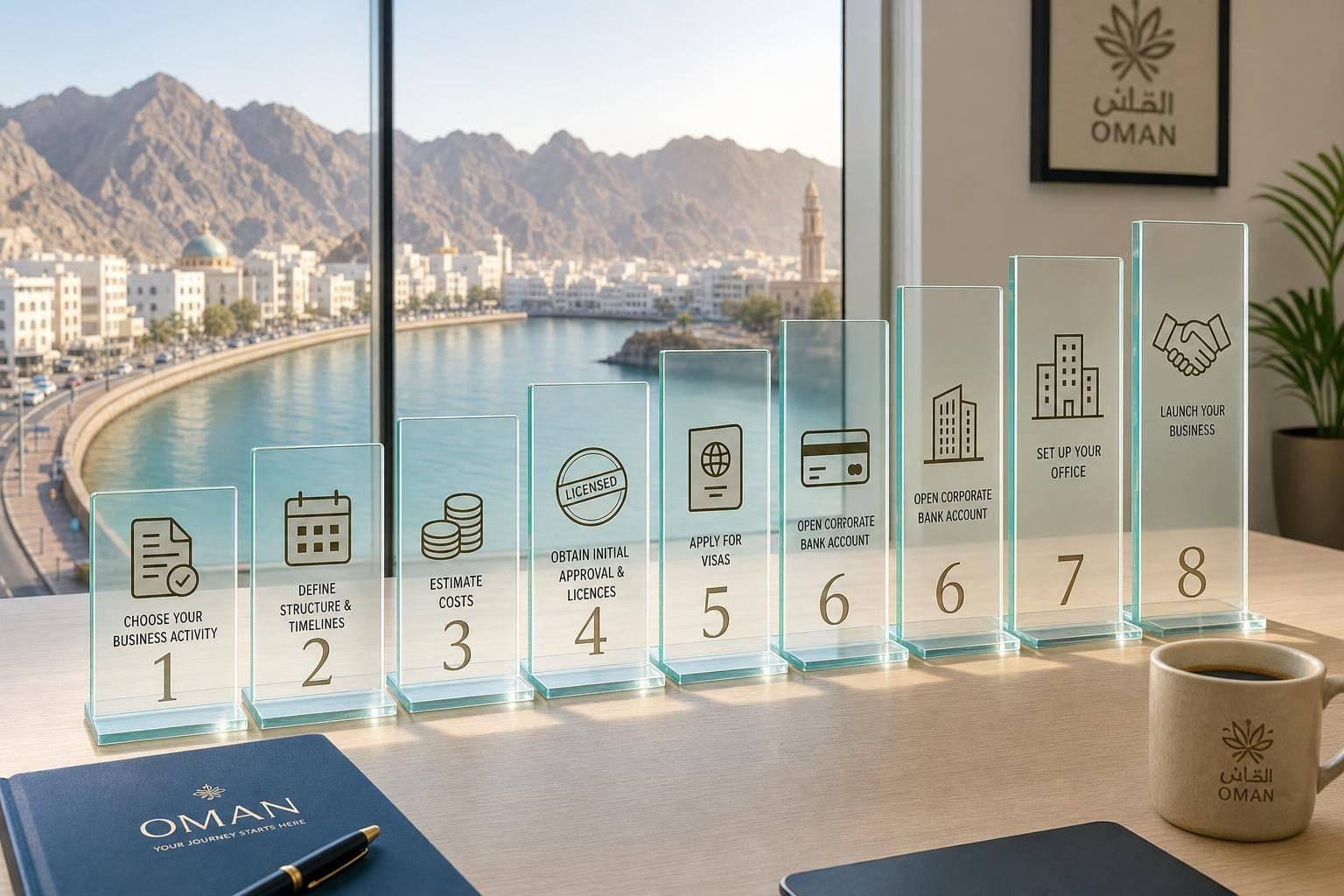
If I wanted to set up a company in Oman, I’d first choose the setup route, then line up the paperwork, then handle registration, licences, tax, labour, visas and banking. That order matters because one wrong choice at the start can slow the whole process.
Here’s the short version:
- Mainland LLC suits most local trading and service businesses
- Branch office suits a foreign company entering Oman for a set contract or project
- Free zone company suits manufacturing, logistics and re-export work
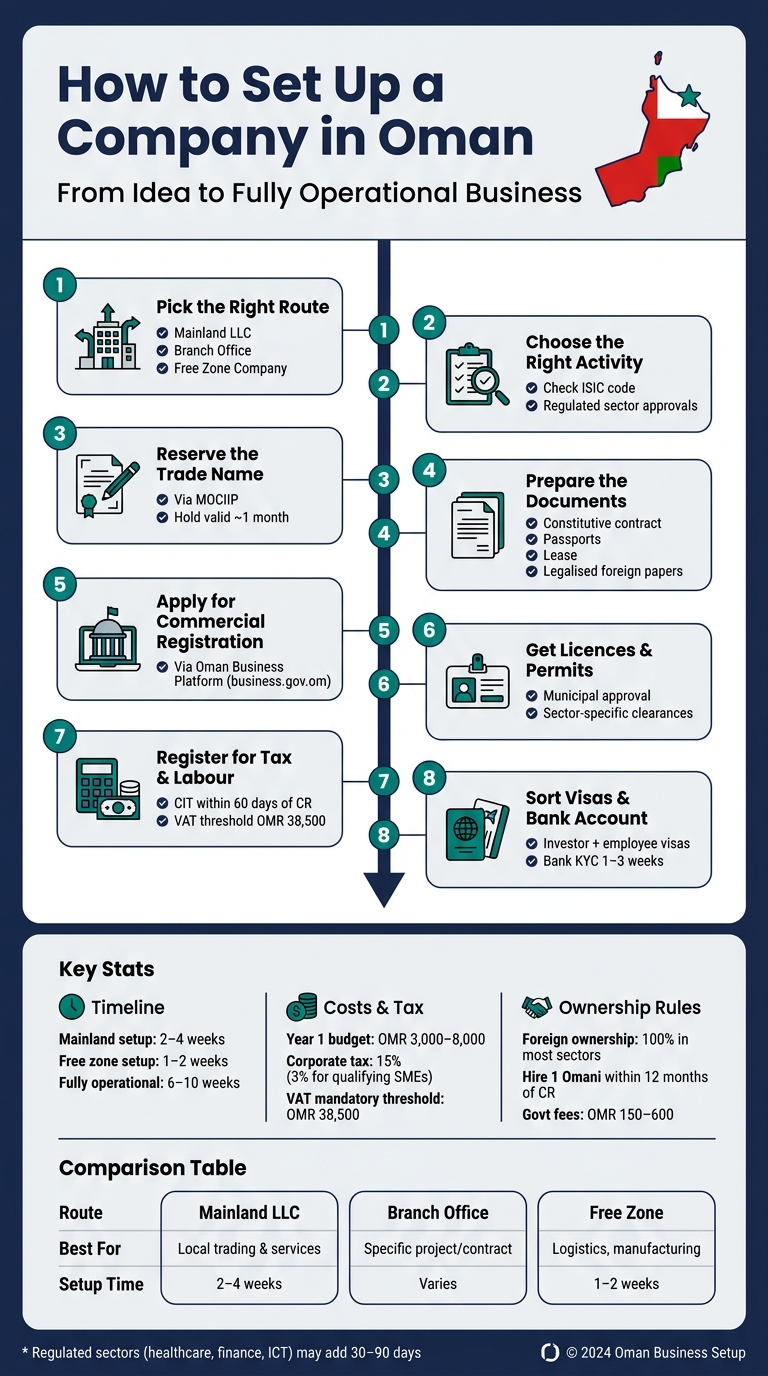
- Mainland setup often takes 2–4 weeks
- Free zone setup may take 1–2 weeks
- Getting fully ready to trade, hire and bank often takes 6–10 weeks
- Many first-year setup costs fall around OMR 3,000–8,000
Before I file anything, I’d make sure I have these points clear:
- the legal structure
- the activity code
- any extra regulator approval
- the trade name
- the attested and translated documents
- the lease and address papers
- the tax, labour and visa plan
A few rules stand out. In most sectors, foreign investors can own 100% of a mainland company. Corporate tax is usually 15%. VAT registration becomes mandatory at OMR 38,500 in taxable supplies over a rolling 12-month period, with voluntary registration from OMR 19,250. Foreign-investor companies must also hire at least one Omani employee within 12 months of commercial registration.
What I take from all this is simple: the setup itself is only part of the job. I’d treat name checks, activity checks, document attestation, post-registration tax work, labour filings and bank KYC as one connected process, not separate tasks.
If I were explaining it in the plainest way possible, I’d break it down like this:
- Pick the right route – mainland, branch or free zone
- Choose the right activity – and check if it needs extra approval
- Reserve the trade name – and keep the spelling the same everywhere
- Prepare the documents – especially legalised foreign company papers
- Apply for Commercial Registration – through the right authority
- Get licences and permits – including municipal and sector approvals
- Register for tax and labour – within the required deadlines
- Sort visas and the bank account – which often take extra time
| Route | Best fit | Foreign ownership | Typical setup time |
|---|---|---|---|
| Mainland LLC | Local trading and services | 100% in most sectors | 2–4 weeks |
| Branch office | Foreign parent on a project | 100% through parent | Varies by approval |
| Free zone company | Logistics, manufacturing, re-export | 100% | 1–2 weeks |
So if I wanted fewer delays, I’d spend more time on the first decisions and the document pack than on anything else. That’s usually what decides whether the process stays on track or drags on.
How to Set Up a Company in Oman: 8-Step Process Guide
How To Start A Business In Oman – Complete Setup Guide & Long-Term Visa Process
sbb-itb-55910af
Step 1: Choose the right company structure, activity and setup route
Before you fill in a single form, make three calls first: the legal structure, the business activity, and whether that activity needs extra approval. Those choices shape the rest of the process. They decide who can own the company, which authority reviews the file, and what comes next.
Start with the setup route. That decision sets the path.
Mainland LLC, branch office or free zone company
A mainland LLC is often the best fit for direct trading in Oman. Since the Foreign Capital Investment Law, 100% foreign ownership is allowed in most sectors, so many investors no longer need a local Omani partner. If your main goal is access to the Omani market and government tenders, this is usually the most direct route.
A branch office works differently. It is not a separate legal entity. It sits under the parent company, which means the parent carries the liability. In practice, branches are often used for a set contract or project. They may also need MOCIIP approval and a project-specific bank guarantee. So this route tends to suit defined work better than broad day-to-day trading.
A free zone company is often a strong option for manufacturing, logistics, or re-export. Free zones usually allow 100% foreign ownership, plus customs exemptions and tax incentives. But there’s a catch: they are mainly built for activity inside the zone or for international trade, not direct mainland sales.
Once you’ve fixed the route, the next job is choosing the right activity code.
| Company Type | Typical Use | Key Authority | Foreign Ownership |
|---|---|---|---|
| Mainland LLC | Local trading, services, government tenders | MOCIIP | 100% (most sectors) |
| Branch Office | Executing a specific government contract | MOCIIP | 100% (parent company) |
| Free Zone Company | Manufacturing, logistics, re-export | OPAZ / Zone Authority | 100% |
Select the correct business activity and check regulated approvals
On the Oman Business Platform, activity codes follow ISIC classifications. That matters more than it may seem at first glance, because the code decides what your company is allowed to do and which approvals may apply.
Before you pick a code, make sure your planned activity is not on the Prohibited List. Oman keeps 70 activities for Omani nationals, including parts of retail, recruitment, and service work. If your sector is regulated – such as financial services, healthcare, engineering, or ICT/cybersecurity – you may need extra approvals from the right ministry or regulator before the licence can be issued. That can stretch a simple registration from a few working days to a few weeks or longer.
This is where people sometimes trip up. If the registered activity does not match the actual business model, problems can show up later. Say a company registers as general trading, but the work is regulated consultancy. Banks and authorities may question it. That can slow down visas, banking, and follow-on licences until the activity is fixed.
It also helps to think about Omanisation and governance from day one. Recent rules say foreign-investor companies must hire at least one Omani citizen within 12 months of commercial registration and submit an employment plan to the Ministry of Labour. If you miss that step, further filings on the Oman Business Platform can be blocked.
So before moving on, check the setup route, confirm the activity code, and review any labour and approval rules early. With those points settled, the next step is reserving the trade name and getting the incorporation documents ready.
Step 2: Reserve the trade name and prepare incorporation documents
Once you’ve fixed the legal structure and activity code, the next job is to lock in the trade name and get the incorporation pack ready before filing with MOCIIP. This is where many avoidable holdups happen. In most cases, the problem is simple: the name doesn’t pass the check, or the documents don’t match.
Reserve a compliant trade name through the MOCIIP system
Reserve the name through the CR application itself. The platform checks the proposed name against existing registrations and the naming rules.
For a mainland LLC, the name must be in Arabic or easy to transliterate into Arabic. You also need to steer clear of religious, political, military and trademark conflicts. And you can only use "Oman" or "Omani" where the rules allow it. If you’re opening a foreign branch, you’ll usually keep the parent company’s legal name.
It helps to prepare three to five backup options before you log in. Approved names are usually held for about a month, so it makes sense to have the rest of the paperwork lined up before you submit.
One small detail can save a lot of time: use the exact same spelling, punctuation and legal form across the CR application, constitutive contract, board resolutions and bank forms. Once the name is approved, stick to one exact bilingual version in every filing.
Prepare the document pack for LLC, branch or investor-led setup
The document pack changes a bit depending on the setup.
For a mainland LLC with individual shareholders, the core file usually includes the constitutive contract, passport copies for each shareholder and the authorised manager, a registered office lease, and specimen signatures. If one of the shareholders is a foreign company, you’ll also need notarised and legalised corporate documents, plus a board resolution that names the signatory.
For a foreign branch, the file is built around the parent company’s papers. That normally means the parent’s commercial registration, constitutional documents, a board resolution authorising the branch and naming the branch manager, a power of attorney for that manager, and a letter of undertaking confirming that the parent accepts liability for the branch’s obligations. You should also include any contract or mandate that supports the branch’s purpose. Recent guidance also points to a UBO declaration for branches, naming individuals with at least 10% ownership or control.
A free zone company follows a similar route, but it also needs a business plan and a zone lease or usufruct agreement. In that case, the file is reviewed by the zone authority – such as OPAZ – rather than MOCIIP directly.
| Document | Mainland LLC | Foreign Branch | Free Zone Company |
|---|---|---|---|
| Constitutive contract / MOA | ✓ | Not required (parent entity) | ✓ |
| Shareholder passport copies | ✓ | Branch manager passport | ✓ |
| Parent company CR & Articles | If corporate shareholder | ✓ (legalised) | If corporate shareholder |
| Board resolution | If corporate shareholder | ✓ (from parent) | ✓ |
| Power of attorney / authorisation | If using a proxy or remote setup | ✓ | If using a proxy or remote setup |
| Parent liability undertaking | Not applicable | ✓ | Not applicable |
| Office lease / registered address | ✓ | ✓ | Zone lease / usufruct agreement |
| Business plan | Not typically required | Not typically required | ✓ |
| UBO declaration | Where required | ✓ | Where required |
For foreign-investor setups, the biggest source of delay is usually document legalisation and Arabic translation. If you’re a UK founder, start that part early so the papers are ready by the time the name approval comes through.
With the file ready, the next stage is CR submission and licence approvals.
Step 3: Apply for Commercial Registration and obtain licences
Submit the Commercial Registration application
With your name reservation in place and the paperwork ready, the next move is to file the Commercial Registration, then work through the licences that come after it.
Submit the Commercial Registration application through the Oman Business Platform (business.gov.om), which is the system used for mainland company registration. To file online, you need a PKI-enabled eID card.
The application usually asks for the trade name, business activity code, capital details, shareholder and manager information, and the business premises address. Make sure every detail matches the approved name, activity code, shareholders, and lease exactly.
If the file is clean and straightforward, CR issuance can take as little as one to two days once all documents are accepted. If the activity needs sector approval, the process can stretch to two to four weeks.
Free-zone filings work in much the same way, but the zone authority handles the process under OPAZ. Land-based projects usually take longer than simple service licences.
Secure trade licences, municipality permits and sector approvals
Once the CR is issued, move straight on to the municipal and sector approvals before you start trading.
The CR gives the company its legal footing, but most businesses still need a trade licence, municipality approval, and sector-specific clearances before they can begin operations.
Municipality approval confirms that the premises are suitable for the chosen activity. This usually means providing a tenancy agreement or lease, proof of the registered address, and, in some cases, a building completion certificate, layout plan, or inspection clearance, depending on the business.
Regulated activities such as healthcare, education, financial services, and manufacturing may also need clearance from the relevant authority before the licence is finalised. That step is often where the longest delay happens.
The table below sums up the two main routes at this stage:
| Mainland (MOCIIP) | Free zone (OPAZ / zone authority) | |
|---|---|---|
| Primary authority | MOCIIP / Oman Business Platform | Relevant zone authority under OPAZ |
| Typical approval sequence | CR application → trade licence → municipality approval | Zone application → lease/plot agreement → zone licence |
| Common bottleneck | Sector approvals, municipal compliance and lease documentation | Land allocation, environmental clearance and zone-specific permits |
| Indicative timeline | Usually a few working days for standard cases; longer where sector approval is needed | Often quick for straightforward cases, but longer for complex projects |
OCCI membership is mandatory. Standard mainland government fees are often OMR 150 to OMR 600, depending on company grade and activity.
Step 4: Complete tax, visa, labour and banking setup
Register for corporate tax, VAT and labour compliance
Once the CR is issued, don’t sit on it. Move straight into the tax, labour, visa and banking filings. Register for corporate income tax within 60 days of CR issuance, file annual returns after year-end, and keep your bookkeeping in place from day one.
Oman’s standard corporate income tax rate is 15%. Qualifying small enterprises may get a reduced 3% rate if they meet the required conditions.
VAT needs attention at the same time. Oman uses a rolling 12-month test. Mandatory registration applies when taxable supplies reach, or are expected to reach, OMR 38,500, while voluntary registration is open from OMR 19,250 in supplies or qualifying expenses. VAT returns and payments are due within 30 days of quarter-end.
Labour compliance should run in parallel with all of this. When you hire your first employee, open a labour file with the Ministry of Labour, enrol Omani staff in social insurance, and plan for the Omanisation quota that applies to your business. If you miss those quota targets, approvals for more foreign work visas can get held up. That’s why it helps to map out headcount and role needs before the first hire, not after.
Arrange investor visas, employee visas and the corporate bank account
Investor visas are processed through the Royal Oman Police once the CR has been issued. In most cases, you’ll need passport copies, company documents, and a shareholder or board resolution appointing the investor as an authorised signatory or manager.
Employee work visas follow a two-stage process. First comes labour clearance from the Ministry of Labour. After that, the visa is issued through the Royal Oman Police. Medical fitness checks and attested certificates are standard at this stage, and processing usually takes two to four weeks once the labour quota position is clear.
Bank account opening often takes one to three weeks. Most delays come from KYC checks. Banks usually ask for:
- The CR
- The memorandum or constitutive documents
- Passport copies for all shareholders and authorised signatories
- A board or shareholder resolution
- Proof of the registered business address
If the company has foreign corporate shareholders, the bank may also ask for group financial statements, UBO declarations, FATCA/CRS forms, and legalised or apostilled UK corporate documents.
Conclusion: A practical checklist for moving from idea to registered business
This process tends to work best when you do each step in order: activity, name, documents, CR, licences, then tax, labour, visas and banking.
The risks are fairly consistent across most setup routes. Pick the wrong activity, miss part of the attestation, or skip a sector regulator approval, and things can slow down fast. In regulated sectors, delays can add 30–90 days if approvals are not started alongside the CR application. Leave tax, labour or banking setup too late, and you can end up with a business that is registered on paper but not ready to invoice, hire or trade.
The gap between a smooth setup and a long, frustrating one usually comes down to what happens before the first submission, not how fast you push things after that. Investors who map their activity properly, set up an attestation schedule, identify sector regulators early, and plan post-registration duties in advance are more likely to reach operational status with fewer resubmissions.
For year one, budget OMR 3,000–8,000 for registration, attestation, lease and professional fees.
Need help with registering your company in Oman? AOWJ’s company formation and business setup services cover it from start to finish. Contact us for a consultation and a clear quote.
FAQs
Which setup route is right for me?
The right setup route depends on who you want to sell to and how you plan to run the business.
If you want to sell straight into the Oman market, a mainland company is the right fit. If your focus is manufacturing, re-export, or serving overseas clients, a free zone company usually makes more sense.
A lot of investors use both. They keep a free zone entity for international trade, then set up a mainland LLC for local operations.
What usually causes delays in Oman company setup?
The most common cause is incomplete or inaccurate documentation. This is especially common when papers need to be properly notarised and attested.
Delays can also happen when a business activity needs approval from a specific ministry. The same goes for trading activities that use the wrong codes or don’t have the right product approvals in place.
Then there’s the corporate bank account stage. That part often takes longer because of KYC checks and the bank’s review process.
When can I start trading after registration?
You can usually start trading once you have your Commercial Registration (CR) and have finished the main post-registration steps, such as registering with the Chamber of Commerce and your local municipality.
For standard activities, the main registration process often takes 3 to 7 working days. Before you begin operations, make sure any sector-specific permits, VAT registration, and tax filings are in place as well.