



If you run a business in Oman, corporate tax starts much earlier than year-end. In most cases, you need to register once the Commercial Registration (CR) is issued, track your books properly, file on time, and keep records for 10 years.
Here’s the short version:
- Most businesses pay 15% corporate tax.
- Some Omani SMEs may qualify for 3% if they meet strict tests.
- Petroleum income can be taxed at 55%.
- Foreign companies can become taxable in Oman through a branch or permanent establishment (PE).
- Taxable profit usually starts with accounting profit and is then adjusted under tax rules.
- Not every expense is deductible, and poor records can lead to denied deductions.
- Some free-zone and sector reliefs may apply, but filing duties usually still remain.
- Related-party payments, intercompany loans, and overseas service charges need support.
- Annual returns are usually due within 4 months of year-end; qualifying SMEs usually have 3 months.
- Late payment can trigger 1% interest per month, and late filing can lead to fines.
A simple example: if a company has OMR 1,500,000 in taxable profit, tax at 15% would be OMR 225,000.
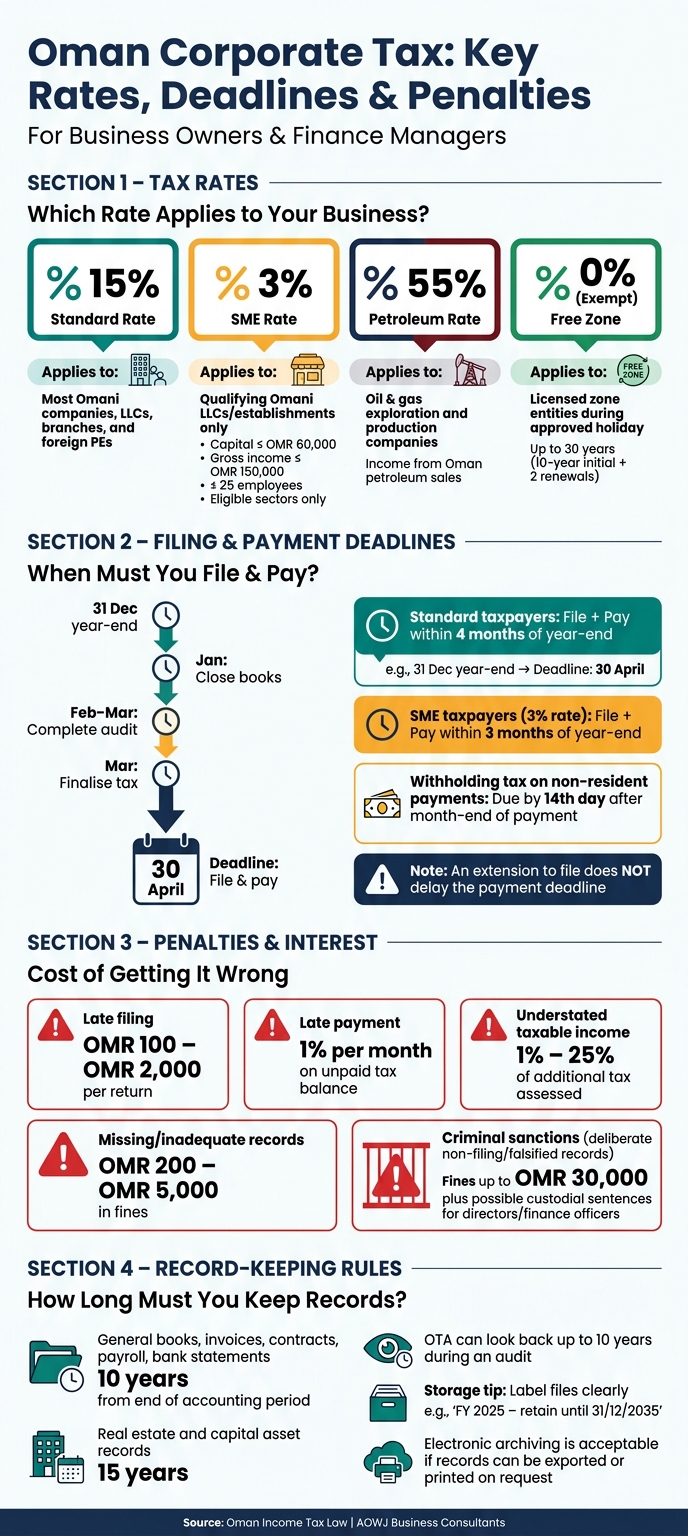
Oman Corporate Tax Rates, Deadlines & Penalties at a Glance
UK vs Oman Taxation Explained | Quick Overview
sbb-itb-55910af
Quick comparison
| Area | Main point |
|---|---|
| Standard rate | 15% |
| SME rate | 3% for qualifying Omani SMEs only |
| Petroleum rate | 55% |
| PE trigger | Often 90 days for certain projects or services |
| Return deadline | Usually 4 months after year-end |
| SME deadline | Usually 3 months after year-end |
| Late payment | 1% per month interest |
| Record retention | 10 years |
I’d treat this article as a plain checklist: who is taxed, which rate applies, what counts as taxable profit, what you can deduct, where exemptions may apply, and how to avoid fines through clean books and on-time filing.
Why Oman corporate tax affects day-to-day business operations
Corporate tax in Oman shapes everyday work. It affects how a business is set up, how contracts are drafted, how invoices are issued, and how records are kept. This starts with the legal and operating structure of the business.
Entity structure affects tax rate and filing obligations. If you operate as a mainland LLC, a branch, a joint venture, or in a free zone, that setup can affect the rate that applies and what you need to file. Permanent establishment (PE) rules add another layer. If a foreign group provides services in Oman for more than 90 days in a 12-month period, or works through an agent acting on its behalf, it can create a taxable presence even without a registered entity. In plain terms, project staffing, contract wording, and where key decisions are made can all have direct tax effects.
Invoicing and intercompany charges are under scrutiny. Day-to-day compliance also depends on how payments between related entities are recorded. The Oman Tax Authority (OTA) actively reviews related-party transactions. So if one group company charges another, the paperwork needs to stand up to review. That usually means written agreements, a clear allocation method, itemised invoices, and proof that the service or goods were actually received. Without that, the deduction may be denied.
IFRS accounting and tax are closely linked. This matters because tax starts with accounting profit and then moves through tax adjustments. Provisions, impairments, fair-value movements, and depreciation recorded under IFRS may not be fully deductible, so these differences need to be tracked in separate tax schedules during the year. Annual tax filings must be backed by audited financial statements prepared under IFRS. So the standard of your monthly bookkeeping feeds straight into audit readiness.
VAT and corporate tax rely on the same underlying data. Both depend on accurate and consistently coded records for every sale, purchase, and adjustment. The same transaction data supports both VAT and corporate tax, which means a coding error in the books can spill into both regimes.
1. AOWJ Business Consultants: Build a compliant tax and bookkeeping system from day one
Once the CR is issued, the compliance setup needs to be in place too. One of the biggest mistakes is starting to trade without a proper tax and bookkeeping system.
Here’s what usually happens when that setup is missing: records get pieced together from bank statements, expenses are signed off informally, and key documents go missing. At that point, the tax return stops being a clean summary of the books and turns into a rebuild job. That means more time, more cost, and a higher chance of estimated assessments.
Every company should register with the Oman Tax Authority and obtain its tax card straight after the CR is issued, no matter its size or expected profit. Businesses with share capital above OMR 50,000 must also prepare audited financial statements.
From day one, the basics should be covered:
- a dedicated business bank account
- a chart of accounts that fits the trading model
- digital invoice capture
- monthly management accounts
- monthly bank reconciliations
- a fixed-asset register
- payroll records
- a filing calendar with automated deadline reminders, plus invoice numbering checks, expense approval reviews, and a scan for unusual transactions
That last part matters more than it may seem. Small errors are much easier to fix when they’re found early, not months later during tax filing.
Cross-border activity adds another layer. If a business has cross-border payments, intercompany charges, foreign ownership, or multiple branches, related-party controls should be built in early. In plain terms, that means signed intercompany agreements, approval workflows for related-party invoices, and support for profit attribution.
Accrual accounting should be used, with source documents attached to each ledger entry. This gives the business a clear trail from any figure in the tax return back to the original invoice or contract. If supplier bills are recorded only when paid, instead of when the expense is incurred, deductions may be overstated. And when that mistake comes to light, the whole tax computation may need to be rebuilt.
AOWJ Business Consultants helps businesses at this stage with entity-level tax reviews, bookkeeping process design, Odoo ERP implementation for finance, payroll, VAT and corporate tax workflows, and deadline management. The aim is simple: build a process that is audit-ready and cut filing risk.
2. Who is subject to Oman corporate tax
Oman’s corporate tax covers more businesses than many owners first assume. The main taxpayer groups are Omani companies, establishments, and permanent establishments of foreign entities. Once a business falls into one of those groups, that sets the tax rate, filing duties, and record-keeping rules that follow.
Omani companies include LLCs, joint-stock companies, company partnerships, and other bodies set up under Omani law, no matter who owns them. So, a UK-owned LLC incorporated in Muscat is still treated as an Omani company and taxed on its worldwide income.
Omani establishments are also within scope. That includes sole proprietorships registered with the Ministry of Commerce, Industry and Investment Promotion. These businesses pay tax on their business profits. If an establishment or LLC meets the SME rules, it may qualify for the 3% rate.
Foreign businesses aren’t automatically outside the tax net just because they don’t have a subsidiary in Oman. A branch or other permanent establishment is taxed on Oman-source income only. A foreign company can also create a PE if it provides services in Oman through personnel for more than 90 days in any 12-month period. A UK engineering firm working on a long project in Oman is a common example. Once the business is within scope, the next job is working out which rate applies.
Free zone companies still need to register with the Oman Tax Authority and meet annual filing and record-keeping duties, even when a tax holiday applies.
In practice, the tax result depends on the legal structure of the business:
| Business Type | Taxed On | Tax treatment |
|---|---|---|
| Omani company, including LLCs and joint-stock companies | Worldwide income | 15% |
| Omani establishment / sole proprietorship | Business profits | 15% or 3% if a qualifying SME |
| Branch or PE of a foreign company | Oman-source income | 15% |
| Foreign company with a service PE | Oman-source income attributable to the PE | 15% |
| Free zone company | Must still register and file; may be exempt under an approved holiday | Exempt during the holiday period |
3. The standard 15% rate, the 3% SME rate, and the 55% petroleum rate
Once you’ve worked out whether a business is in scope, the next step is simple: which tax rate applies? In Oman, there are three main corporate income tax rates, and each one applies to a different group of taxpayers.
The 15% standard rate applies to most taxable businesses. For ordinary business profits, there isn’t a general tax-free threshold. If the business is taxable, the starting point is usually 15%.
The 3% SME rate is much narrower. It’s only open to qualifying Omani proprietorships and LLCs, and the conditions are strict. The business must have registered capital of no more than OMR 60,000, annual gross income of no more than OMR 150,000, and no more than 25 employees on average during the tax year. On top of that, some sectors are shut out, including banking, insurance, air and sea transport, natural resource extraction, and public utility concession businesses. Foreign-owned LLCs and branches can’t use the 3% rate at all.
The 55% petroleum rate applies to companies involved in oil and gas exploration and production, but only on income from Oman petroleum sales. In practice, the tax base is usually set under the concession or production-sharing agreement, with ring-fencing and cost-recovery rules shaping how much income is taxed.
For most businesses, the answer will be 15%. Here’s the quick view:
| Taxpayer type | Applicable rate | Key condition |
|---|---|---|
| Omani company or foreign-owned LLC | 15% | Standard rate |
| Branch or PE of a foreign company | 15% | Oman-source taxable income |
| Qualifying Omani SME (LLC or establishment) | 3% | Capital ≤ OMR 60,000; income ≤ OMR 150,000; ≤25 employees; eligible sector |
| Petroleum exploration and production company | 55% | Income from Oman petroleum sales; governed by concession contract |
If a business is trying to stay within the SME band, it makes sense to check those thresholds through the year, not just at year end. Breach even one of them, and the business moves to 15% for that tax year. The rate is only part of the picture, though. After that, the key issue is how Oman deals with branches, tax residence, and permanent establishments.
4. How tax residence, branches, and permanent establishments are taxed
After the tax rate, the next issue is where Oman can tax a business.
Tax residence decides whether Oman taxes worldwide income or only profits linked to Oman. A company is resident in Oman if it is incorporated there, or if a foreign company is managed from Oman.
Foreign companies are taxed only on Oman-source profits tied to a branch or permanent establishment (PE). If there is no branch or PE, they are usually outside the scope of Omani corporate tax. That means PE analysis is not just a tax exercise; it also needs to be checked when contracts are drafted. Even without a PE, some Oman-source payments may still face 10% withholding tax.
Under Oman’s income tax law, a PE includes any fixed place of business through which a foreign company carries on business in Oman. That can include an office, factory, workshop, mine, or place of management.
Time thresholds matter too. A construction, assembly, or installation project that lasts more than 90 days in any 12-month period creates a PE. The same applies where consultancy services are provided in Oman for 90 days or more in a 12-month period. A dependent agent who habitually signs contracts on behalf of the foreign company can also create PE status.
In practice, the line can be crossed more easily than people expect. Repeated consulting trips, a project site that keeps running, or a local representative signing deals informally can all tip a foreign company into PE status.
Once a PE exists, the foreign company should:
- register with the Oman Tax Authority
- keep local books
- file annual tax returns
It also helps to track days spent in Oman through timesheets or travel records, and to test each project against the 90-day threshold before the contract is signed.
5. What counts as taxable income in Oman
Once you know the tax rate, the next step is working out the tax base. In Oman, taxable income usually starts with IFRS profit before tax and then gets adjusted for items the tax law includes or leaves out. So the starting point is accounting profit, but it does not mean every figure in the accounts is taxed.
Taxable income can include trading revenue, service fees, rental income, interest, foreign exchange gains linked to business operations, capital gains on business assets, and royalties or technical fees.
Some accounting gains are usually left out for tax purposes, even if they appear in the IFRS accounts. This often includes revaluation gains and unrealised foreign exchange movements. Insurance recoveries, compensation payments, and government grants linked to revenue can also be taxable, so each item needs a proper review before the year-end tax computation.
Dividend income needs a close look too. Dividends received from other Omani companies are exempt from corporate tax. Foreign dividends are generally taxable unless a specific exemption applies. Gains on shares listed on the Muscat Securities Market are also exempt.
The table below shows the income categories that often trip businesses up:
| Income type | Tax treatment |
|---|---|
| Trading revenue, service fees, project income | Taxable as ordinary business income |
| Interest, foreign exchange gains related to business operations | Taxable |
| Business asset gains | Taxable at the standard corporate rate |
| Muscat Securities Market listed share gains | Exempt |
| Dividends from Omani companies | Exempt |
| Foreign dividends | Generally taxable unless a specific exemption applies |
| Revaluation gains, unrealised FX movements | Excluded from taxable income |
| Royalties, management fees, technical fees | Taxable; withholding tax may also apply |
6. Which business expenses are deductible and which are disallowed
Once income has been classified, each cost has to pass the deduction test. A business can deduct an expense only when it is incurred wholly and exclusively for earning business income, linked to the trade, and supported by records such as invoices, contracts, bank statements, or payroll files.
That paperwork matters more than many businesses expect. If the records are missing, the Oman Tax Authority can reject the expense. When that happens, taxable income goes up, and that can lead to extra tax, interest, and penalties.
Typical deductible expenses include staff salaries, mandatory social security contributions for Omani employees, office and warehouse rent at market rates, utilities, insurance premiums for business premises, audit fees, and standard legal and accounting fees. Bad debts that have been written off and tax depreciation on fixed assets are also allowed.
One point often trips people up: buying an asset is not the same as deducting it straight away. Capital expenditure itself is not immediately deductible. Instead, the business claims the yearly depreciation charge under the tax rules.
Some costs are plainly disallowed. These include Oman corporate income tax, general provisions and reserves, expenses connected to exempt income, losses on disposal of Muscat Securities Market-listed securities, costs already recovered through insurance or a court award, and fines or penalties that come from breaking a legal obligation.
The table below is a handy sense-check at year end.
| Expense | Deductible? | Key condition |
|---|---|---|
| Salaries, mandatory social security contributions, statutory employee dues | Yes | Must be employment-related and documented |
| Office rent, utilities, insurance premiums for business premises | Yes | Rent should be market-based and commensurate |
| Audit, legal, and accounting fees | Yes | Must relate to business operations |
| Tax depreciation on fixed assets | Yes | At rates set by tax regulations, not IFRS policy |
| Capital expenditure (asset purchase cost) | No | Deducted only via depreciation over time |
| Oman corporate income tax paid | No | Explicitly disallowed |
| General provisions and reserves | No | Narrow exceptions for banks and insurers only |
| Fines, penalties, breach-of-contract costs | No | Non-deductible regardless of business context |
| Donations to approved organisations | Capped | Maximum 5% of gross income |
| Related-party interest exceeding 2:1 debt-to-equity | Excess disallowed | Financing structure directly affects tax |
A practical way to stay on top of this is to prepare a year-end tax adjustment schedule in OMR. That schedule should list every add-back, such as non-deductible taxes, disallowed provisions, excess interest, and fines. It also helps to keep separate general ledger codes for non-deductible items from the start, so the tax return is less of a scramble later on.
If a cost fails the deduction test, the next step is to check whether a specific exemption or relief changes the position.
7. Exemptions, free-zone tax holidays, and sector reliefs
Once you’ve worked out what you can deduct, the next step is simple: check whether any profit is exempt before the 15% corporate tax rate kicks in. Not all Oman-source profit is taxed at 15%, so it would be a mistake to apply that rate across the board.
Under the 2025 OPAZ framework, eligible businesses in approved zones can get an initial 10-year corporate tax exemption. That exemption can then be renewed twice, which means the total holiday can run for as long as 30 years.
| Zone | Maximum tax holiday | Key sectors |
|---|---|---|
| Duqm Special Economic Zone | Up to 30 years | Heavy industry, energy, fisheries |
| Salalah Free Zone | Up to 30 years | Logistics, pharmaceuticals, chemicals, green hydrogen |
| Al Mazunah Free Zone | Up to 30 years | Warehousing, food processing, border trade |
| Sohar Free Zone | Up to 25 years | Metals, petrochemicals, logistics |
There is one catch, though. These holidays apply only to approved zone income. If the same business also runs mainland activities, that mainland income does not get pulled into the holiday.
Outside the zones, the scope is much tighter. Mainland industrial, meaning manufacturing, activities in Oman can still qualify for a five-year, non-renewable corporate tax exemption. But the old, broader sector holidays that once covered areas like tourism, agriculture, mining, and education were mostly removed after reforms around 2017.
And no, exemptions do not just appear because a company is in the right place or sector. You need to apply in the proper way, meet the stated conditions, and keep meeting them during the holiday period. That usually includes things like:
- minimum capital investment
- Omanisation hiring quotas
- operating only within approved activities
- keeping separate records for exempt income and taxable income
That last point matters more than many businesses expect. Exempt income should be shown separately in both your accounting records and your tax computation.
Some sectors are carved out from zone holidays altogether, no matter where they are based. This includes banks, financial institutions, insurance and reinsurance companies, telecoms, construction firms, and land and maritime transport businesses. So if your company falls into one of those groups, the standard 15% rate still applies even if you are physically inside a free zone.
Even if a tax holiday is available, related-party pricing and profit allocation must still hold up under review.
8. Related-party rules, arm’s-length pricing, and cross-border risk areas
Free-zone relief does not switch off arm’s-length pricing or cross-border tax rules. If related-party pricing pushes taxable income down or makes losses look bigger than they should, that can draw attention fast. So if a business sits inside an overseas-owned group, or has cross-border group dealings, those transactions need to be priced at arm’s length from day one.
Under Oman’s income tax law, related parties include entities under common control through majority capital, voting rights, or rights to most profits or assets, as well as individuals related up to the third degree of kinship. If the pricing or terms differ from what independent parties would agree and that lowers taxable income, the OTA can recalculate taxable income on an arm’s-length basis. The same approach applies when profits are allocated to branches or permanent establishments.
Debt funding needs the same level of care. A group can think of an intercompany loan as a simple funding tool, but if leverage gets too high, a deductible interest cost can stop being deductible. Oman applies a thin-capitalisation rule: interest on related-party debt is deductible only if the borrower’s debt-to-equity ratio does not exceed 2:1. Any interest above that limit is disallowed. In practice, the OTA pays close attention to management fees, royalties, IP licensing payments, and intercompany loans. That means groups using shareholder loans more heavily than equity need to keep a close eye on leverage.
Oman also charges 10% withholding tax on royalties, management fees, technical service fees, and software usage rights paid to non-residents with no permanent establishment in Oman. A double tax agreement may cut that rate, so it makes sense to check Oman’s treaty position before any payment goes out. For larger multinational groups, the reporting bar is higher too. Groups with consolidated annual revenue of OMR 300 million or more must notify by year-end and file the Country-by-Country Report within 12 months of the year-end.
Oman does not require a formal transfer-pricing file, but that does not mean the OTA will take a relaxed view. It still expects contracts, functional analyses, and benchmark studies to be ready for review during an audit. Put simply, if the numbers only make sense after a long verbal explanation, that’s a warning sign. These positions need to be tracked cleanly across filings, payments, and audit support.
9. Filing deadlines, tax payment dates, and 10-year record-keeping duties
Deadlines matter just as much as the numbers. File late, and tax compliance can turn into a cash-flow headache as well as a penalty risk.
The annual corporate tax return is due within four months of the financial year-end. If your year-end is 31 December, both the return and any remaining tax due must be submitted by 30 April of the next year. SMEs using the 3% rate have a shorter window. They must file and pay within three months.
One point catches people out all the time: an extension to file does not push back the payment date. The tax is still due on the original deadline. If tax stays unpaid, interest applies at 1% per month from that original due date. On an unpaid OMR 100,000 for three months, that works out to about OMR 3,000 in interest.
Returns and payments are made online through the OTA portal. Audited financial statements also need to be ready well before filing, because standard taxpayers submit them with the return. For a 31 December year-end, the timetable usually looks like this:
- Close the books in January
- Finish the audit by late February or early March
- Finalise the tax position in March
- File by 30 April
That only works if the finance records are up to date. Monthly closes and bank reconciliations make the deadline far easier to hit.
Deadlines only hold up when the books underneath them are complete and easy to trace. Every figure in the return should link back to source documents in case the OTA reviews the filing. Taxpayers must keep books, records, and supporting documents for at least 10 years from the end of the accounting period they relate to. This includes general ledgers, journals, sales and purchase invoices, contracts, bank statements, payroll records, and all working papers used to prepare the tax return.
For records tied to real estate or capital assets, the retention period can stretch to 15 years. The OTA may inspect records at the taxpayer’s premises with advance notice, and it can look back over records from the previous 10 years.
A simple filing system helps more than most businesses expect. Keep original copies of key legal documents and tax notices, and store day-to-day records digitally by accounting period. Clear labels save time later. For example: "FY 2025 – retain until 31/12/2035".
The exact filing profile then varies by business type, which is where many compliance mistakes begin.
10. Penalties, interest, and the most common compliance mistakes
Once you move past the filing and record-keeping rules, the next problem is simple: the cost of getting things wrong.
Miss the filing deadline, and you could face a penalty of OMR 100 to OMR 2,000, even if the tax itself was paid on time. On top of that, any unpaid tax balance is charged interest at 1% per month – or part of a month – from the due date until the amount is settled. In plain terms, filing late and paying late are two separate risks.
If the Oman Tax Authority decides that taxable income was understated, it can also charge an extra penalty of 1% to 25% of the additional tax. This often comes up when deductions are disallowed, Oman-source income was left out, or related-party pricing was not at arm’s length.
| Compliance failure | Potential exposure |
|---|---|
| Late filing of return | OMR 100–2,000 per return |
| Late payment of tax | 1% per month on unpaid balance |
| Understated taxable income | 1%–25% of the additional tax |
| Missing records | Fines generally OMR 200–5,000 |
Some groups tend to face more risk than others, especially SMEs, foreign branches, and free-zone entities. A common slip-up is assuming the 3% SME rate applies by default. Another is treating a free-zone tax holiday as if it removes the need to file. It doesn’t. These businesses still need registration, annual returns, and records kept for 10 years.
At the far end of the scale, the stakes get much higher. Deliberate non-filing, falsified records, or wilful concealment of income can lead to criminal sanctions, including fines of up to OMR 30,000 and possible custodial sentences for directors and finance officers responsible for the breach.
Use the quick-reference tables below to check the main rates, deadlines, and record-keeping duties at a glance.
Tax rates and reliefs at a glance
Use this table as a quick way to spot the right regime before you move on to filing dates and record-keeping duties.
| Regime | Rate | Applies to | Main conditions | Duration |
|---|---|---|---|---|
| Standard mainland | 15% | Most Omani companies, branches, and foreign entities with a permanent establishment in Oman | Default regime for commercial, industrial, and professional activities | Indefinite |
| Small enterprise (SME) | 3% | Qualifying Omani proprietorships and LLCs | Capital up to OMR 60,000; annual gross income up to OMR 150,000; up to 25 employees; excluded sectors do not qualify | While eligibility criteria are met |
| Petroleum | 55% | Companies engaged in oil and gas exploration and production | Income derived from the sale of petroleum, usually under concession or Exploration and Production Sharing Agreement arrangements | Per contract or concession |
| Free zone / SEZ (e.g. Duqm, Sohar, Salalah) | Income tax exemption | Entities licensed in and operating from a qualifying zone | Zone licence, minimum investment, Omanisation compliance, and zone-specific activity requirements | Up to 10 years initially, renewable twice |
A couple of points matter here.
The 3% SME rate is not automatic. You need to meet the size tests and other rules, and current Oman Tax Authority guidance should be checked before relying on it.
For free-zone entities, the exemption only covers approved zone income. If the same business also earns mainland income, that mainland income stays taxable. And if you’re running a general commercial or service business, that does not put you in the petroleum regime.
Once you’ve pinned down the right regime, the next step is checking filing deadlines and how long records must be kept.
Key filing dates, books of account, and records to keep
Once you know the filing deadline, the next step is simple: keep the records that back up the return. In Oman, withholding tax on payments to non-residents must be paid over by the 14th day after the end of the month in which the payment was made or credited.
Oman’s Income Tax Law also says every taxpayer must keep all books of account and source documents for at least 10 years from the end of the accounting period they relate to. So if you’re keeping Oman tax records, work to the local 10-year retention rule.
These records support deductions, related-party charges, and WHT positions if the OTA reviews the return. The main files businesses should keep are below.
| Document category | What to keep |
|---|---|
| Core accounting books | General ledger, day books, journals, trial balance, chart of accounts |
| Transaction support | Sales and purchase invoices, customer and supplier contracts, order forms |
| Personnel and payroll | Employment contracts, monthly payroll summaries, payslips, social security contribution records |
| Banking | Bank statements for all accounts, reconciled to the ledger |
| Fixed assets | Asset register showing description, acquisition date, cost, depreciation rate, location, and disposal details |
| Related-party and WHT | Intercompany agreements, management fee arrangements, arm’s-length pricing support, WHT calculations, payment receipts |
| Trade and customs records, where relevant | Bills of entry, bills of lading, packing lists, freight invoices, customs duty receipts |
| Statutory audit | Signed audited financial statements, audit reports, management letters, tax computation schedules |
Related-party files and withholding tax records need extra care. Oman allows a long 10-year retention and enquiry window, so the Tax Authority may look at much older transactions. If the paperwork is patchy, deductions can be denied and extra assessments can follow.
Take a common example. If a UK parent charges a Muscat subsidiary a management fee, the file should include the services agreement, proof that the work was done, such as emails, reports, and timesheets, plus the WHT calculation and the remittance receipts kept with that year’s tax records.
From a storage point of view, electronic archiving is fine as long as records can be exported or printed when asked for. A plain folder structure by year and document type works well – for example, 2025 – Sales invoices, 2025 – Payroll, and 2025 – Fixed assets – and makes old files much easier to find later on.
The main risk points change from one business to another, which is where the next section starts to matter most.
How the rules apply by business type: where errors usually happen
The same tax rules can trip up different businesses in different ways. It often comes down to structure. A setup that looks fine for one entity can create a tax problem for another, so it helps to know where mistakes usually show up.
Mainland LLCs often get caught out by the SME rate. The 3% rate is often used when a business no longer qualifies, and if a trading LLC keeps applying it after its status changes, it can face a reassessment at 15%, plus penalties and interest. Another common issue is treating capital items as repairs and maintenance instead of capitalising them and claiming depreciation. Capital expenditure is not deductible as a current expense, so it will usually be added back on audit.
Foreign branches tend to run into deduction issues on head-office overheads. General head-office overheads are capped at 3% of branch gross income, with higher limits for banks, insurance, and certain high-tech activities. If a foreign group recharges its full share of central overheads without applying that cap, the excess may be disallowed. Branches also need to keep an eye on permanent establishment exposure. If staff, offices, or key decision-making functions are present in Oman, the OTA may treat the activity as a taxable PE where the facts show a real business presence in Oman.
The picture shifts again when a business operates in both a zone and the mainland.
Free-zone entities often claim more relief than they can support. Tax holidays can run for up to 30 years, but the relief applies only to qualifying activities within the zone. For example, a logistics company registered in a free zone that runs customer-facing operations in Muscat may still be treated as having a mainland PE, with those profits taxed at 15%. If the business does not keep separate accounts for zone and mainland activity, that position becomes much harder to defend.
Group structures bring another pressure point: paperwork.
Foreign-owned companies often do not have enough support for related-party payments abroad. Related-party payments abroad need written support and arm’s-length pricing, and the OTA looks closely at intra-group charges. Without a written intercompany agreement and proof that the services were actually delivered, the deduction can be denied in full. Royalty payments also need evidence of IP ownership and a commercial basis for the rate used.
| Business type | Most common error | Core risk |
|---|---|---|
| Mainland LLC | Misapplying the 3% SME rate; expensing capex | Back-assessment, penalties and interest |
| Foreign branch | Exceeding the cap on general head-office overheads | Excess overhead disallowed; taxable income rises |
| Free-zone entity | Assuming the tax holiday covers mainland activity | Mainland activity taxed at 15% |
| Foreign-owned company | Weak support for related-party payments | Deduction denied; taxable income adjusted |
Conclusion
Corporate tax compliance is manageable, but it takes steady control. The basics are simple: confirm taxable status, apply the right rate, calculate profit correctly, keep support for related-party dealings, file on time, and retain records for 10 years
The tax rate matters. But in day-to-day practice, filing and payment deadlines are usually what lead to penalties. SMEs file within three months of year-end, while standard taxpayers file within four months. Tax payment follows the same timetable as filing. Miss the deadline and penalties can range from OMR 100 to OMR 2,000, plus 1% monthly interest on unpaid balances
Before filing, check three things:
- Your chart of accounts clearly separates taxable and non-taxable income and flags disallowed expenses
- Core documents are stored for 10 years, with backups in place
- Any PE exposure, SME eligibility issue, or cross-border pricing matter is settled before filing
That shifts tax control from a year-end scramble to a monthly finance habit
If your team needs support with registration, filing, or record-keeping, AOWJ Business Consultants can help. Treat compliance as an ongoing finance process, not a once-a-year task.
Need help with corporate tax registration and filing? AOWJ’s tax advisory and VAT services cover it from start to finish. Contact us for a consultation and a clear quote.
FAQs
Do I need to register for corporate tax as soon as my CR is issued?
Yes. Tax registration with the Oman Tax Authority is mandatory for all companies once your Commercial Registration (CR) is issued. That includes small enterprises too, no matter how much profit they make.
After you receive your CR, you should treat tax, VAT and labour registration as a core part of the company formation process.
How do I know if my business qualifies for the 3% SME rate?
To qualify for the 3% SME rate, your business must meet the Oman Tax Authority’s rules on capital, annual revenue, and employee numbers.
Oman’s standard corporate income tax rate is 15%. That’s a big gap. So it pays to keep accurate books of account and file annual returns properly. Good records help confirm that you qualify and can also help you avoid compliance penalties.
What records should I keep to support my tax return in Oman?
You should keep properly prepared financial accounts to support your corporate tax return in Oman. Those records need to follow IFRS and the rules set by the Oman Tax Authority.
If your company’s share capital is more than OMR 50,000, or the business meets certain size thresholds, the financial statements must also be audited by a licensed auditor. That’s why it pays to keep your books accurate and audit-ready from the start. It makes annual filings much easier and helps you avoid penalties.