


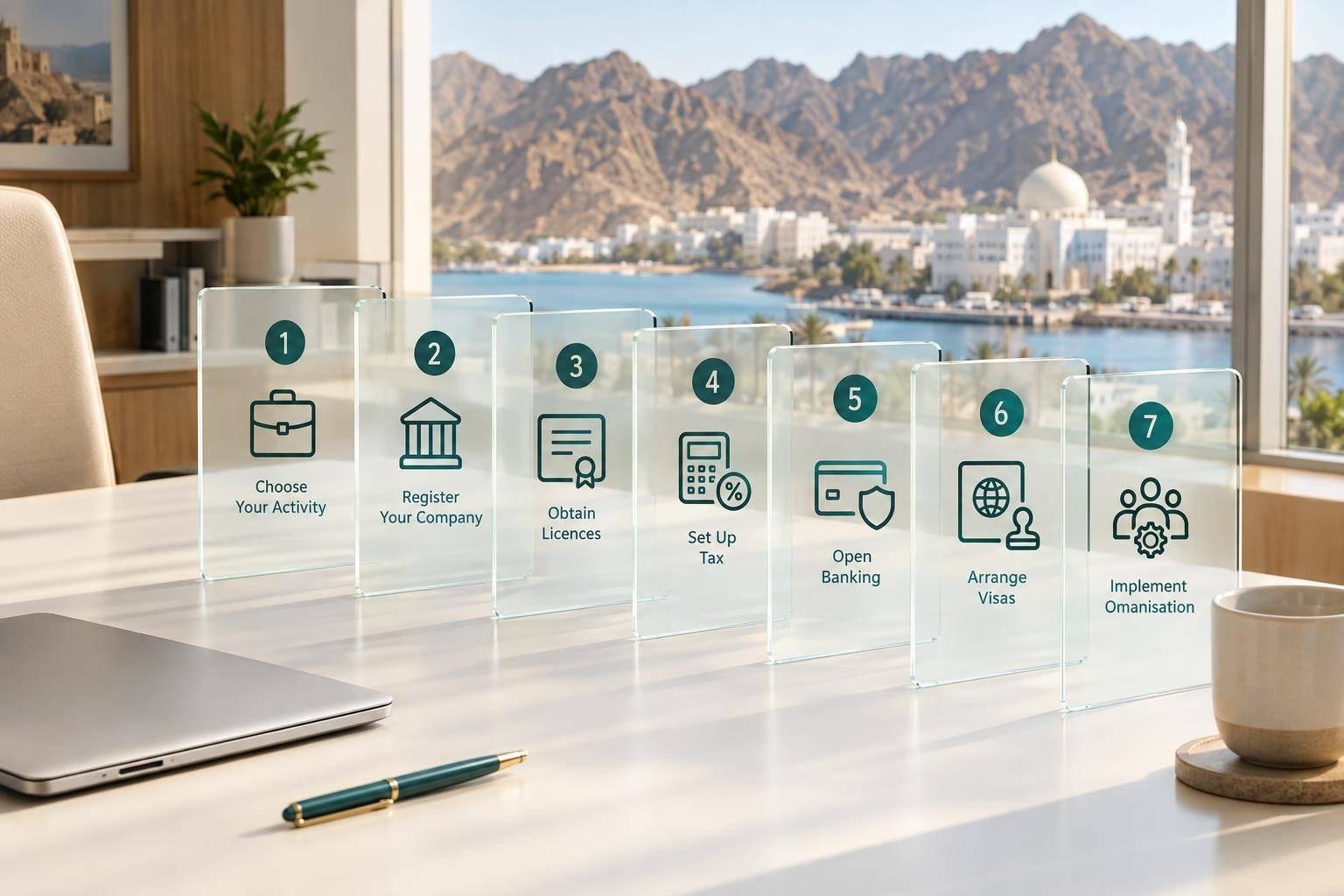
You can own 100% of a business in many activities in Oman – but check your exact activity code before spending money. I recommend confirming foreign-ownership rules and required approvals on the Oman Business Platform before signing a lease.
Here’s the setup plan I’d follow:
- Choose your route: Mainland or zone registration, then a legal form that fits your ownership, liability and funding needs.
- Prepare and apply: Gather documents, check certification and translation requirements, reserve a name and apply for commercial registration. <u>Registration alone does not mean you can start trading.</u>
- Budget for the whole setup: Include licences, premises, document checks and advisory fees. Costs and timescales depend on your application.
- Plan tax and banking: Register for income tax within 60 days of registration or starting activity, whichever comes first. Check VAT registration at OMR 38,500 in annual taxable supplies; the standard VAT rate is 5%. Bank approval is a separate process.
- Prepare for hiring and deadlines: Arrange work and residence permissions, payroll and Omanisation checks. Track tax filings, records, renewals and company updates from day one.
My starting rule: confirm what you can do, where you can do it and which permissions you need – then commit your budget.
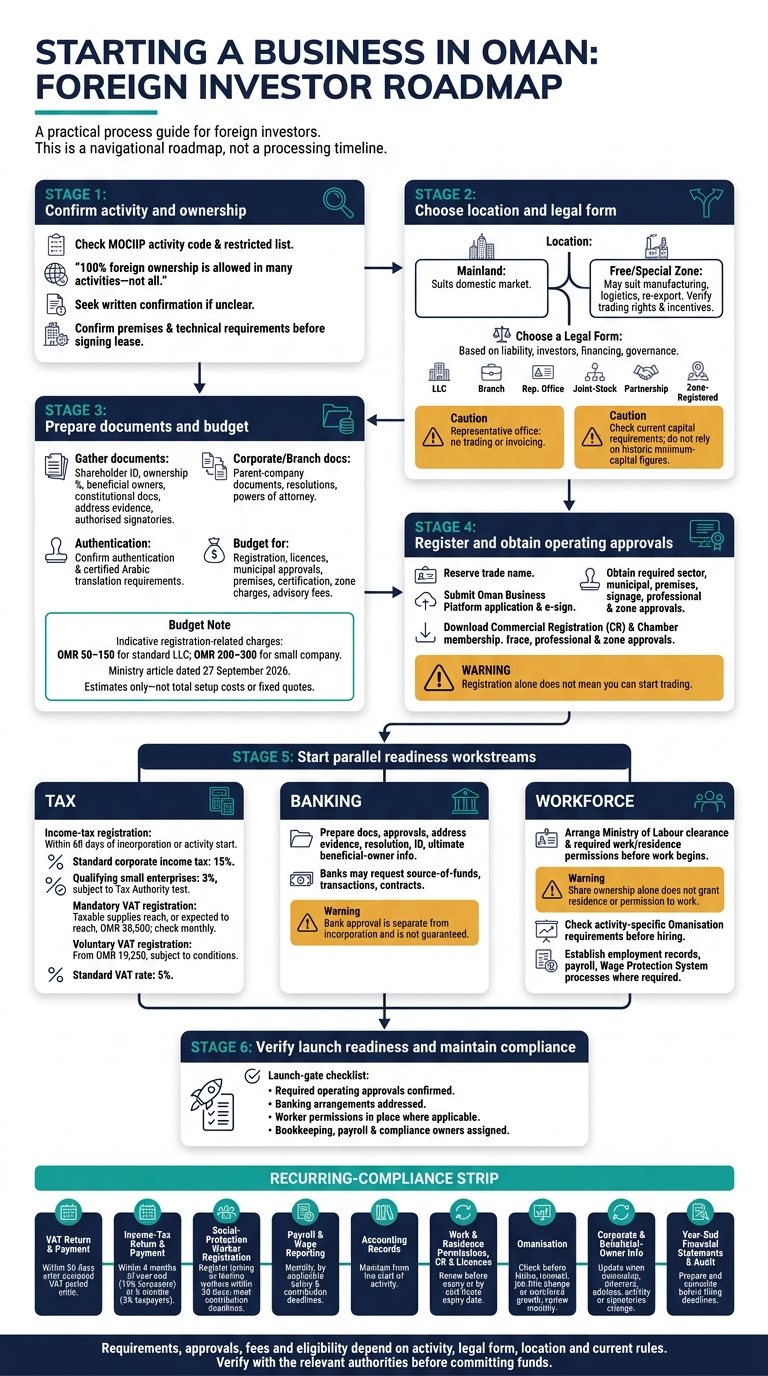
Starting a Business in Oman: Foreign Investor Roadmap
Choose Your Business Activity and Structure
Check Foreign Ownership Rules
Start with the exact MOCIIP activity code. Check the restricted-activities list for ownership limits and any extra approvals.
Automotive repair, translation and interpretation, and labour recruitment require particular attention: their treatment depends on the code and current rules.
If the wording is unclear, get written confirmation before filing.
Send MOCIIP or the relevant regulator a short activity statement covering your services, customers, delivery method, premises, equipment, imports, activity code and proposed shareholders. Ask whether:
- 100% foreign ownership is allowed, or a local partner or qualification is required.
- The premises must meet technical requirements, and which approvals you need first.
Health, education, transport and other regulated activities may need separate approval from the relevant authority.
Once your activity is cleared, compare mainland and zone registration based on your target market and how you plan to run the business.
Choose Mainland or Zone Registration
Base your choice on where you will sell, operate and store goods. Mainland registration generally suits businesses serving Oman’s domestic market. A free zone or special economic zone may suit manufacturing, logistics and re-export operations better.
Check permitted activities, suitable premises, lease terms, customs treatment and the process for selling into mainland Oman with the zone operator or the Public Authority for Special Economic Zones and Free Zones (OPAZ).
Zone incentives depend on the jurisdiction and activity. Get eligibility, duration and tax treatment in writing before committing to a site. For industrial projects, also confirm the environmental approval category before committing.
Then match your legal form to your liability, funding and governance needs.
Compare Legal Entities
Choose a structure that fits your investors, liability, financing and management needs. Confirm the current company-law and MOCIIP requirements before proceeding.
Do not base your budget on a historic minimum-capital figure. Check activity, legal-form and zone requirements separately.
| Entity | Suitable use | Liability and governance | Ownership, capital and licensing checks |
|---|---|---|---|
| LLC | Trading, services, industrial or project businesses | Separate legal person; liability is generally limited to contributions; managed by appointed managers | Shareholder numbers, capital rules and activity-specific operating licences. |
| Branch of a foreign company | Performing an identified parent-company contract | Overseas parent remains responsible for branch obligations | Parent-company evidence, approved scope and contract-based requirements. |
| Representative office | Market research, promotion and liaison | Parent-linked, with a limited non-trading role | No trading or invoicing. Permitted functions and reporting duties apply. |
| Joint-stock company | Larger projects needing high levels of financing, multiple investors or a formal share structure | More complex governance and reporting requirements; shareholder liability is generally limited | Minimum capital, shareholder rules and sector approvals. |
| Partnership | Partner-led business | Liability and management depend on the form; some forms expose partners to high levels of personal liability | Foreign participation, permitted activities and registration conditions. |
| Zone-registered company | Export, logistics, industrial or other zone-supported activities | LLC or another approved form, with additional zone governance and licensing | Zone licensing, capital and lease conditions, incentive eligibility and mainland-trading rights. |
Once you have chosen the structure, gather the documents and file the registration applications.
sbb-itb-55910af
Prepare Documents and Apply for Registration
Gather the Required Documents
Once you’ve chosen the legal form, gather passport copies for shareholders and managers, proposed trade names, ownership percentages, beneficial-owner details, constitutional documents, proof of the registered address, authorised signatory details and required declarations. The documents you need depend on the legal form. Branches, representative offices and corporate shareholders should also prepare foreign parent corporate documents, an authorising resolution and any required power of attorney.
Check document authentication requirements first. Confirm whether foreign-issued records need notarisation, legalisation, an apostille where recognised, certified Arabic translation, and original or certified copies. Regulated applications may also need professional qualifications, experience records, a business plan or project summary, a feasibility study or a capital deposit certificate.
Submit Registration and Licence Applications
With your documents ready, submit the MOCIIP application and seek any sector or zone approvals. Use the reserved trade name consistently across every application document.
On the Oman Business Platform, select the legal form and enter shareholder, manager, ownership, address and activity details. Upload the documents, e-sign the forms, respond to authority queries and pay the invoice. Foreign-owned entities should check whether the foreign investment route applies. Prepare any extra project details, staffing estimates, experience evidence, feasibility study or preliminary security clearance requested. Save the application number, submitted documents, receipts and approval notices. Once approved, download the CR and Chamber membership certificate.
CR does not cover every activity-specific approval. Obtain municipal, premises, signage, health, engineering, professional or sector approvals where required. Zone businesses also need approvals from the relevant operator. Record each approval, the responsible authority, required documents and conditions that must be met before trading.
Estimate Setup Costs and Timelines
Before filing, map out the likely fees and common causes of approval delays.
An official Ministry article dated 27 September 2026 gives indicative registration-related charges of OMR 50–150 for a standard LLC and OMR 200–300 for a small company.
These figures are estimates, not fixed quotes. Check the official fee schedules and your application invoice for the actual charges. Allow time for document preparation, authentication, registration review and approvals needed to start trading. Inconsistent names, missing resolutions, unsuitable premises and security or sector reviews can delay completion.
| Cost category | What to include | Where to verify the amount |
|---|---|---|
| Registration | CR, Chamber membership, amendments and renewals | MOCIIP invoice and Chamber fee schedule |
| Licences | Investment, sector and professional permissions | Relevant authority’s tariff |
| Municipal approvals | Premises, signage and municipal charges | Municipality’s schedule and premises classification |
| Premises | Rent, deposit, fit-out and engineering work | Written lease and contractor quotations |
| Certification | Notarisation, legalisation, apostille, certified translation and courier charges | Required authentication route and written quotations |
| Zone charges | Registration, lease, operator services and permits | Relevant zone operator’s schedule |
| Advisory fees | Legal, accounting and application support | Separate written quotation stating scope and exclusions |
Once approvals are in place, move to tax, banking and employment compliance.
Set Up Tax, Banking and Employment Compliance
Once the CR is issued, start handling tax, banking and staffing requirements straight away.
Register for Tax and Open a Bank Account
The authorised signatory must register the company with the Oman Tax Authority within 60 days of incorporation or the start of activity, whichever comes first. The standard corporate income-tax rate is 15%. Qualifying small enterprises may pay 3%, subject to the Tax Authority’s eligibility test.
Check VAT registration requirements monthly using both backward-looking and forward-looking tests. Registration is mandatory when taxable supplies reach, or are expected to reach, OMR 38,500. Voluntary registration may be available from OMR 19,250, subject to the applicable conditions. The standard VAT rate is 5%. Once registered, issue compliant tax invoices, separate standard-rated, zero-rated and exempt supplies, and reconcile input and output VAT.
A director or authorised signatory should prepare the bank application. Include the CR, constitutional documents, activity approvals, proof of address, an account-opening resolution, shareholder and authorised-user identification, and ultimate beneficial-owner information.
Bank approval is separate from incorporation and is not guaranteed. Banks may ask for proof of the source of funds, transaction details and contracts. You must also notify them of changes to ownership, control or signatories.
While the bank application is under way, arrange workforce permissions before anyone starts work.
Arrange Visas, Payroll and Omanization
Share ownership alone does not grant residence or permission to work in Oman. Employees normally need Ministry of Labour clearance before starting the employment visa and residence process. Check each person’s role, nationality, salary and workforce permissions before they begin work.
Omanisation rules vary by sector. Check the rules for your activity, occupations and headcount before hiring or renewing permits. HR should register the employer with the relevant labour and social-protection authorities, and keep signed contracts, identity documents, work permissions, salary, leave and employment records.
Use a documented monthly payroll process that covers wages, deductions, overtime, salary transfers and applicable contributions. Use the Wage Protection System where required. Keep the workforce register up to date and review it regularly.
Plan Your First-Year Compliance Deadlines
Track obligations from day one: several begin at incorporation, not when the company first makes a profit. Give each task a named owner and a backup. Check dates against the company’s tax year, portal notices, worker status and licence conditions.
| Obligation | Deadline or trigger | Responsible person |
|---|---|---|
| Income-tax registration | Within 60 days of incorporation or the start of activity, whichever comes first. | Authorised signatory or tax adviser |
| VAT registration | Taxable supplies reach, or are expected to reach, OMR 38,500; voluntary registration from OMR 19,250, subject to conditions. | Finance manager |
| VAT return and payment | Within 30 days after the assigned VAT period ends. | Finance manager or tax adviser |
| Income-tax return and payment | Within four months of year-end for 15% taxpayers; three months for qualifying 3% taxpayers. | Finance manager and tax adviser |
| Accounting records | Maintain from the start of activity; retain invoices, ledgers, contracts and working papers | Accountant |
| Financial statements and any required audit | Prepare year-end financial statements; complete any required audit before filing deadlines | Director and appointed auditor |
| Payroll and wage reporting | Monthly, by salary and contribution deadlines | Payroll manager |
| Social-protection registration and contributions | Register joining or leaving workers within 30 days; meet applicable contribution deadlines. | HR and payroll manager |
| Work and residence permissions | Before work begins; renew before expiry. | Government-relations manager |
| Omanisation review | Before hiring, permit renewal, job-title changes or workforce growth; review monthly | HR manager |
| CR and activity licence renewals | By each certificate’s expiry date | Corporate secretary or authorised representative |
| Corporate and beneficial-owner updates | When ownership, directors, address, activity or signatories change | Director or corporate secretary |
Conclusion: Your Business Setup Checklist
Use this checklist as your pre-launch gate. Assign an owner to each item and keep supporting evidence. Before filing, confirm your activity code, foreign-ownership eligibility, location and legal form.
Work through the remaining steps in the same order you filed them:
- Documents, name and premises: Complete shareholder, manager and constitutional documents, including required legalisations and translations. Reserve your trade name and confirm the premises before committing to a lease or fit-out.
- Registration and approvals: File CR, Chamber membership and all required sector, municipal or zone licences together. Record pending approvals and confirm authorisation to trade.
- Compliance calendar: Put first-year tax registration, VAT monitoring and income-tax filing dates into one calendar.
- Operational readiness: Cover bank account opening, visas, work permits, contracts, payroll, Omanisation, bookkeeping, filings, renewals and corporate-record updates. Link each item to a filing date or renewal reminder.
For a scope-specific consultation with AOWJ Business Consultants, share your nationality, ownership plan, activity, location, premises status, staffing needs and launch date. Ask for an itemised estimate separating advisory, government and third-party costs. Approvals, costs and processing times depend on your application and the relevant authorities. Use the review to confirm the right structure, approvals and filing plan before launch.
Need help with setting up your company in Oman? AOWJ’s company formation and business setup services cover it from start to finish. Contact us for a consultation and a clear quote.
FAQs
Can I register an Omani company from abroad?
You can register and own an Omani company without living in Oman or visiting the country. By granting a power of attorney, you can authorise a licensed consultancy to handle registration on your behalf. The consultancy submits documents, including passport copies and constitutive contracts, through the Oman Business Platform.
Once your Commercial Registration (CR) is issued, you can apply for an investor visa to relocate to Oman.
Can I add new business activities after registration?
Yes, you can add new business activities after registration by updating your Commercial Registration (CR) through the Invest Easy / Oman Business Platform. The activities must not appear on the restricted negative list reserved for Omani nationals.
AOWJ Business Consultants can check whether your new activities are eligible and handle the required updates to your registration and licensing requirements.
What obligations apply if my company stays inactive?
An inactive company still has filing and registration duties. It must continue corporate tax filings and VAT reporting, maintain Oman Tax Authority registrations, keep its Commercial Registration (CR) valid, and meet statutory audit or accounting requirements to avoid penalties.
If you don’t plan to resume trading, formally closing the business requires a shareholders’ resolution, settlement of all liabilities, tax clearance and cancellation of the CR. The process typically takes three to six months.