



I start IFRS conversion in Oman with three working documents: a gap checklist, an opening-balance reconciliation and an action plan. Before changing any figures, I confirm the reporting framework and transition date – being an SME does not automatically mean you can use IFRS for SMEs.
My approach covers five steps:
- Confirm the rules: establish which framework applies, the reporting dates and required comparisons.
- Fix records and policies: rebuild unsupported balances and document accounting decisions.
- Check opening values: review assets, impairment and tax, then reconcile approved adjustments.
- Review contracts: apply the relevant lease and revenue rules – not just invoice or payment dates.
- Prepare for audit: assign owners and deadlines, approve journals and link each material adjustment to supporting records.
The numbers matter. In the article’s lease example, OMR 12,000 a year for five years, discounted at 8%, creates an initial lease liability of about OMR 47,914 – not simply an annual rental expense.
My guiding rule: <u>resolve material gaps before posting adjustments</u>. That means checking the records, calculation and approval before a figure reaches your IFRS statements.
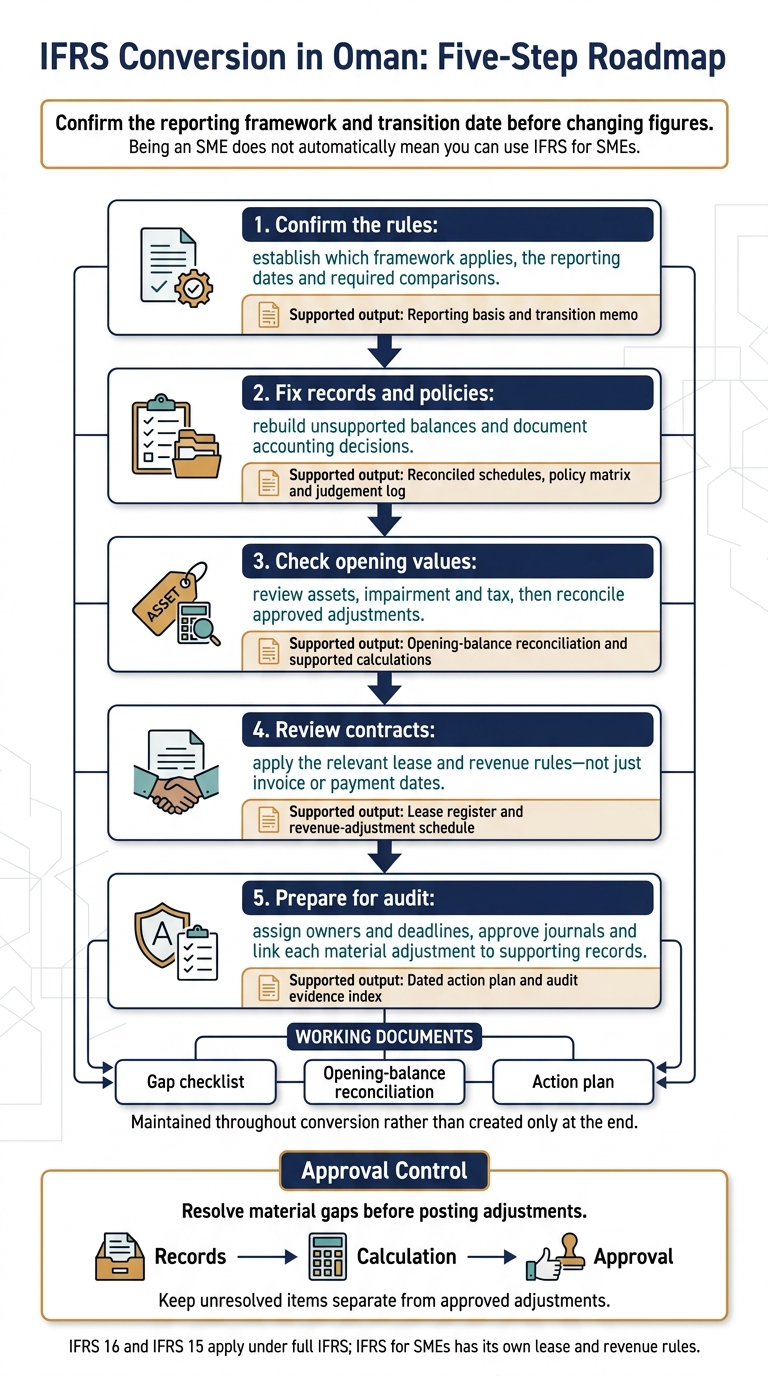
IFRS Conversion in Oman: Five-Step Roadmap
2. Fix Missing Records and Inconsistent Policies
Rebuild Unsupported Account Balances
Turn each gap-assessment item into an opening balance backed by evidence. Export the transition-date trial balance and keep the original ledger. Rebuild balances from source records, then reconcile banks, receivables, payables and fixed assets to that evidence. A ledger balance alone does not prove the amount is correct. Use the reconciled balances as the starting point for asset valuation, opening-balance and IFRS 16/IFRS 15 work.
Missing supplier invoices can understate liabilities and expenses or inventory; incomplete asset records can misstate assets and depreciation.
Keep a reconciled schedule and proposed journal for each issue. Tag each balance as supported, partly supported, unsupported or judgement-based. Separately, log each issue as supported, unresolved or requiring judgement, alongside its journal, owner and review date.
Where originals are missing, record the substitute evidence and its limits. Do not automatically clear unexplained amounts to retained earnings. First, establish whether they reflect an error, impairment, an omitted transaction or a valid balance. Keep unresolved items separate from approved adjustments.
Agree Accounting Policies and Record Judgements
Once the balances are rebuilt, agree the accounting policy for each area and document the judgement behind it. Compare branch and entity practices with the selected framework.
For depreciation, record methods, useful lives and commissioning dates. For inventory, keep costing and net-realisable-value tests. Back provisions with contracts and legal evidence, foreign-currency treatment with currency and exchange-rate records, and borrowing-cost decisions with loan terms and qualifying-asset schedules. Financial instrument judgements need contracts and impairment models; impairment reviews need forecasts and sensitivity analysis. State how each revised treatment affects assets, liabilities, profit, equity and disclosures.
Under IAS 8, apply policy changes retrospectively, correct errors retrospectively and recognise estimate changes prospectively, subject to impracticability exceptions and any different requirements under IFRS 1 or another standard.
Approve a policy matrix and judgement log that link conclusions to evidence, affected periods, calculations, journals, tax effects and disclosures. Record finance director approval and the next review date, then transfer approved adjustments into the opening-balance reconciliation. These adjustments also inform the asset, lease and revenue reviews that follow.
sbb-itb-55910af
3. Correct Asset Values and Opening Balances
Check Asset Recognition, Valuation and Impairment
Start with the supported balances from the previous section when testing assets and calculating opening IFRS adjustments. At the transition date, reconcile the fixed-asset register, inventory records, receivables subledger and subsidiary ledgers to the general ledger. Check mismatches between ledgers and registers, duplicate entries, disposals still on the books and fully depreciated assets still in use.
Confirm that each balance has the evidence IFRS requires. Check capitalised repairs, maintenance, training and similar spending against IAS 16. Errors in opening values also affect later depreciation and disposal gains.
For each material asset class, record original cost, accumulated depreciation, accumulated impairment, useful life, residual value, depreciation method and carrying amount. Recalculate depreciation from the date the asset was available for use. Where appropriate, account separately for components with materially different useful lives.
If historical cost records are incomplete, check whether an IFRS 1 deemed-cost election is available and suitable. Apply it asset by asset, only where justified. Support valuations with an independent valuer’s report, the valuation methodology, key assumptions and management approval. Do not extend the election to unrelated balances.
Once you have recalculated asset values, include the net adjustment in the opening IFRS statement of financial position.
Each asset type needs its own test. Measure inventory at the lower of cost and net realisable value, supported by ageing reports, recent selling prices, expected selling costs and evidence of obsolescence. Assess trade receivables under IFRS 9 using historical default rates, current conditions and reasonable forward-looking information.
For non-financial assets under IAS 36, check impairment indicators and compare the carrying amount with the recoverable amount: the higher of value in use and fair value less costs of disposal. If an asset does not generate independent cash inflows, test the relevant cash-generating unit.
Prepare the Opening-Balance Reconciliation
Build an account-by-account bridge from the previous-framework trial balance to the opening IFRS statement of financial position. Keep reclassifications, measurement adjustments and tax effects separate. Support every line with calculations and source records.
Under IFRS 1, transition adjustments arising from differences between previous accounting policies and IFRS policies must be recognised directly in retained earnings or, where appropriate, another category of equity.
Replace the illustrative figures below with the entity’s balances and verified calculations. Amounts remain in OMR.
Account Previous-framework balance (OMR) IFRS reclassification (OMR) Measurement adjustment (OMR) Tax effect (OMR) IFRS opening balance (OMR) Evidence Review status Property, plant and equipment 1,200,000 – (60,000) 9,000 1,149,000 Asset register, disposal documents, depreciation recalculation Approved Inventory 300,000 – (45,000) 6,750 261,750 Ageing report, NRV test, sales evidence Finance review Trade receivables 850,000 – (70,000) – 780,000 Receivables ageing, ECL model, subsequent receipts Audit review Retained earnings Previous closing balance – Net opening measurement adjustments Net tax effect Reconciled opening retained earnings Approved In progress
Calculate deferred tax for each temporary difference by comparing the revised IFRS carrying amount with its tax base. Use the applicable enacted or substantively enacted tax rate, and recognise deferred tax assets only when IAS 12 recognition requirements are met.
Link each material adjustment to its calculation, source records, journal and IFRS 1 disclosure impact. Carry the same evidence trail into lease and revenue balances in the next phase.
4. Apply IFRS to Leases and Revenue
Once asset values have been reset, turn to lease and revenue contracts. These often produce the largest opening adjustments. Use the agreed framework, transition date and elections to recalculate the balances. IFRS 16 and IFRS 15 apply under full IFRS; IFRS for SMEs has its own lease and revenue rules.
Prepare an IFRS 16 Lease Register
Gather property, vehicle and equipment contracts from procurement, legal, facilities and fleet records. Check service agreements for embedded leases: arrangements where the contract gives control of an identified asset.
For each lease, record the commencement date, payment timetable, renewal and termination options, incentives, index-linked changes, non-lease components and supported discount rates. Assess short-term and low-value exemptions rather than applying them automatically. Keep refundable deposits separate and assess their treatment as financial instruments.
Reconcile the register regularly with the ledger and bank payments. Link every entry to its contract, calculation file, disclosure working paper, journal entry and opening-balance reconciliation.
Hypothetical Oman SME applying full IFRS: a five-year property lease starts on 1 January 2027, with OMR 12,000 payable at each year-end. Assume an 8% annual incremental borrowing rate, no incentives, initial direct costs, restoration obligation or non-lease components. The initial lease liability is approximately OMR 47,914, calculated as 12,000 × [1 − (1.08)⁻⁵] ÷ 0.08. Debit the right-of-use asset and credit the lease liability by that amount. Straight-line annual depreciation is approximately OMR 9,583. First-year interest is OMR 3,833; the OMR 12,000 payment reduces principal by OMR 8,167, leaving approximately OMR 39,747 outstanding. These are commencement calculations, not automatic transition-date balances: use the actual contract history and applicable transition elections or reliefs when converting an existing lease.
Review Customer Contracts Under IFRS 15
Reassess existing revenue using the five-step model: identify the contract and its performance obligations, determine the transaction price, allocate it using relative stand-alone selling prices, and recognise revenue when or as each obligation is satisfied. An invoice or cash receipt does not, by itself, trigger revenue recognition.
Prepare a contract review matrix covering the contract reference, performance obligations, transaction price, timing, variable consideration, financing terms, modifications, warranties and principal-versus-agent judgements. Separate contract assets from unconditional receivables. Where performance remains outstanding, record customer advances as contract liabilities.
| Existing recognition trigger | IFRS 15 assessment | Adjustment | Contract evidence |
|---|---|---|---|
| Invoice issued for a year’s service | Assess whether the service transfers over time and choose a suitable progress measure | Defer the unearned portion as a contract liability | Signed contract, service dates and progress reports |
| Deposit received before equipment delivery | Establish whether control has transferred | Reverse premature revenue; recognise a contract liability | Purchase order, bank receipt and delivery or acceptance records |
| One invoice for equipment, installation and maintenance | Assess distinct performance obligations and allocate the price | Recognise each component when or as its obligation is satisfied | Contract, stand-alone prices, installation sign-off and maintenance schedule |
| Gross billing for a service arranged through an intermediary | Determine whether the business controls the service before transfer | Recognise net commission if acting as agent | Supplier agreement, customer terms and fulfilment responsibilities |
Hypothetical support contract: an Oman SME receives OMR 24,000 upfront for 12 months of evenly provided support starting on 1 October 2027. Assuming no other factors change the recognition pattern, revenue to 31 December 2027 is OMR 6,000, with OMR 18,000 remaining as a contract liability. If the full receipt had been recorded as revenue, debit revenue and credit the contract liability by OMR 18,000. Put this calculation in a revenue-adjustment schedule showing existing and IFRS revenue, receivables, contract balances, reporting period, journal, tax or other consequential effects and evidence references. Reconcile it to the customer ledger and conversion workings, supported by the signed contract and service reports.
Carry approved lease and revenue adjustments into the opening-balance reconciliation and action plan.
5. Complete the Conversion and Prepare for Audit
Set Actions, Owners and Review Dates
Keep the remaining work on track with a dated conversion action plan. Treat the timetable below as a planning template, not a reporting deadline. Assign separate preparers, reviewers and approvers where possible. Management remains responsible for accounting decisions and the final statements. Link each action to its checklist item, journal and evidence file.
Use clear status labels: not started, in progress, awaiting evidence, awaiting approval, complete and blocked. Set review dates for material or high-judgement items rather than relying only on the final reporting deadline.
| Workstream | Issue | Action | Owner | Evidence | Target date | Status | Financial-statement impact |
|---|---|---|---|---|---|---|---|
| Framework | IFRS transition date not formally documented | Approve transition memo and reporting basis | Finance director | Board approval, prior financial statements | 5 October 2026 | Awaiting approval | All statements and disclosures |
| Gap assessment | Missing records and policy gaps | Complete checklist; obtain records from legal, procurement and operations | Financial controller | Gap report, source records | 12 October 2026 | In progress | Affected balances |
| Policies and adjustments | Material judgements unresolved | Approve policies; calculate asset, lease and revenue adjustments | Management and finance | Policy memos, reviewed calculations | 16 October 2026 | Awaiting approval | Assets, liabilities, income and expenses |
| Opening balances and journals | Unsupported retained-earnings differences | Approve journals; reconcile opening IFRS equity | Chief accountant | Journal approvals, reconciliation | 23 October 2026 | In progress | Equity |
| Comparatives and disclosures | Transition reporting incomplete | Reconcile comparatives; complete notes and management review | Reporting manager | Draft statements, disclosure checklist | 30 October 2026 | Not started | Comparatives and notes |
IFRS 1 requires reconciliation of previous-GAAP equity to IFRS equity at transition and at the end of the latest comparative period. It also requires reconciliation of comparative comprehensive income. Separate previous-GAAP errors from changes in accounting policy – do not combine them into one unexplained equity adjustment.
Organise Audit Evidence and Reporting Controls
Create an evidence index for every material adjustment. Record the adjustment reference, account affected, IFRS requirement, source document, calculation file, journal number, approval evidence, reviewer, date and final ledger reference. Flag missing evidence and assign someone to follow it up.
Before releasing the statements, agree the conversion trial balance and the lease and revenue sub-ledgers to the general ledger. Also agree opening IFRS equity to the approved opening-balance reconciliation.
Keep separate IFRS-to-tax reconciliation schedules. Accounting entries should not flow automatically into Omani tax returns. Document each book-to-tax difference in the conversion file, along with its tax treatment, responsible reviewer and tax advice memo.
Use the approved checklist and opening-balance reconciliation as the control point for final sign-off. Test configured workflows and retain management approval of judgements and journals. Set independence safeguards where the firm or its network also acts as statutory auditor. Advisers must not approve their own work on management’s behalf.
Conclusion: Address Material Gaps First
Tackle material unsupported balances and high-judgement contracts first. Obtain evidence and approval before posting adjustments, then close the remaining open items in the checklist, reconciliation and action plan. Discuss unresolved material issues with the auditor before finalisation.
Need help with your IFRS conversion? AOWJ’s audit and assurance services cover it from start to finish. Contact us for a consultation and a clear quote.
FAQs
How do I confirm which IFRS framework applies in Oman?
Speak to a professional advisory firm that specialises in local regulations and IFRS practices. Your reporting obligations may depend on your company’s legal structure, size and location – including whether it operates on the mainland or in a free zone.
A qualified consultant can review your Commercial Registration (CR) and operating status to confirm which reporting framework applies. They can also help ensure your company meets the standards expected by the Oman Tax Authority and other relevant regulators.
What if I cannot recover missing accounting records?
If you can’t recover missing accounting records, you must carry out a thorough forensic investigation to reconstruct the financial data. AOWJ Business Consultants can help identify gaps and collect the supporting evidence still available.
If primary documents are permanently lost, work with your advisers to develop reasonable estimates or alternative audit-grade reconciliations that meet IFRS requirements. This keeps your opening balances reliable and audit-ready for the transition.
Which IFRS 1 exemptions can simplify my conversion?
The search results provided do not list specific IFRS 1 exemptions. Check the official IFRS 1 First-time Adoption of International Financial Reporting Standards documentation for details on optional exemptions that may simplify your conversion, as well as the mandatory exceptions that apply.