



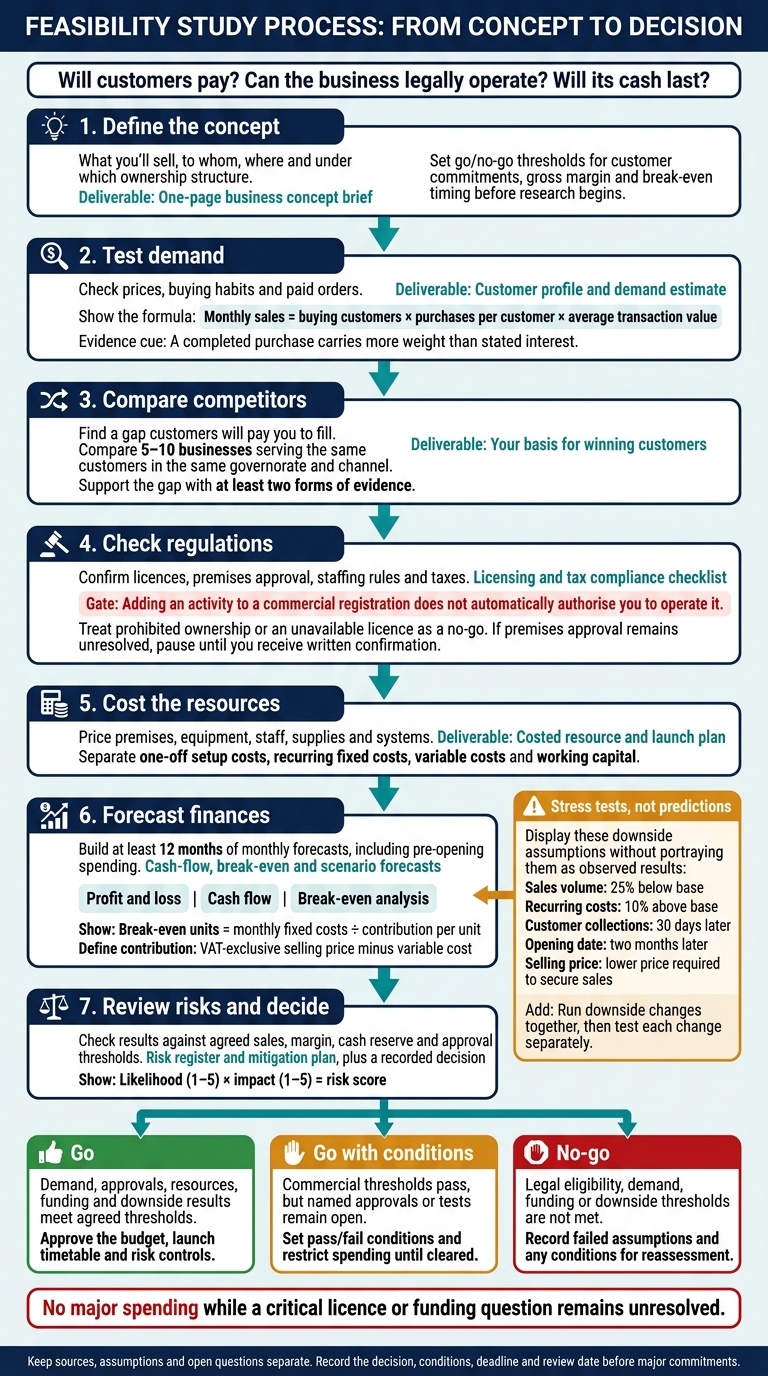
Before investing in Oman, I’d check three things: will customers pay, can the business legally operate, and will its cash last? I’d set limits for demand, start-up funding and cash runway before signing a lease or buying stock.
My feasibility study would cover these seven steps:
- Define the concept: what I’ll sell, to whom, where and under which ownership structure.
- Test demand: check prices, buying habits and paid orders.
- Compare competitors: find a gap customers will pay me to fill.
- Check regulations: confirm licences, premises approval, staffing rules and taxes.
- Cost the resources: price premises, equipment, staff, supplies and systems.
- Forecast finances: build at least 12 months of profit, cash-flow and break-even forecasts.
- Review risks and decide: proceed, revise and retest, or stop.
For the cash test, I’d model sales 25% below forecast, costs 10% higher and customer payments 30 days later – as stress tests, not predictions.
My rule: <u>no major spending while a critical licence or funding question remains unresolved</u>. I’d keep sources, assumptions and open questions separate, then use the results to make a recorded go/no-go decision.
Feasibility Study in Oman: 7 Planning Steps
Starting a Business in Oman 2024 Real Fact #businessplan
sbb-itb-55910af
Step 1: Define Your Business Concept
Set out what you’ll sell, who will buy it and what problem it solves. Explain how you’ll earn revenue and why customers will choose your offer. Add the unit of sale, pricing model and sales channel. Replace vague claims with benefits you can measure.
Choose the Activity, Location and Ownership Structure
Define every activity that will generate revenue, including whether you’ll import, manufacture, store or deliver goods. Match each activity to its classification on the Oman Business Platform. List the approvals you’ll need before estimating costs and launch timing. Adding an activity to a commercial registration does not automatically authorise you to operate it. These classifications guide what you can test next.
Specify the governorate, town or free zone, along with the premises you’ll need. Check customer access, utilities, delivery distances and any location-specific conditions.
Record the legal form, shareholders, ownership percentages and management responsibilities. Full foreign ownership is permitted in many sectors, but eligibility depends on the activity. Check whether your activity qualifies rather than assuming it does.
Separate funding into founder equity, shareholder loans and external finance, and set your intended launch date.
Deliverable: One-Page Business Concept Brief
Keep the brief to one page. Include the activity and classification, customer problem, target customer, offer, unit of sale, pricing model, sales channel, location, ownership, key resources, funding and launch timeline.
Before research begins, set go/no-go thresholds for customer commitments, gross margin and break-even timing.
End the brief with unresolved decisions: price acceptance, purchase frequency, ownership eligibility, premises approval and the licensing authority. For each point, state what evidence you need and the deadline for obtaining it. Keep the brief provisional until those checks pass. It will serve as the baseline for Step 2, where you test whether customers will buy.
Step 2: Assess Market Demand
Use the concept from Step 1 to estimate who will buy, how often and at what price in the area you can serve. Combine local customer research with official data. Population growth or national spending figures alone won’t support a sales forecast.
Test Customer Interest, Prices and Sales Channels
Define your customers by governorate, neighbourhood, need, purchasing power and buying habits. For business customers, record their industry, company size, who approves purchases and how long procurement takes.
Check population, household and sector data through Oman’s National Centre for Statistics and Information (NCSI). Its reported average monthly household income for 2025 was OMR 1,839.3 for Omani households and OMR 717.2 for expatriate households. Use these figures only as affordability benchmarks – not proof of demand.
Interview potential buyers about what they use now, their pain points, budget and buying process. Then test realistic prices through surveys, paid trials or pre-orders. Record whether each price includes VAT, delivery and other charges.
A completed purchase carries more weight than stated interest. For each sales channel, track the enquiry-to-order rate, acquisition cost, cancellations and repeat purchases – not just clicks. Keep an evidence log that records sample size, limitations and confidence level.
Deliverable: Customer Profile and Demand Estimate
Prepare a worksheet covering the target customer, buying trigger, objections, preferred channel, addressable customer numbers, tested price range and purchase frequency. Limit the estimate to customers you can reach and serve.
Calculate monthly sales = buying customers × purchases per customer × average transaction value. Then check that your delivery reach and capacity can support those sales.
Produce conservative, central and optimistic forecasts, accounting for Ramadan, holidays, school terms and relevant tourism seasons. Base the central forecast on paid orders and verified contracts. Don’t multiply one strong trial month by 12 without evidence.
Compare the results with your demand thresholds. Flag any assumptions about price, conversion or repeat purchases that need another test before you use them in the financial forecast. Step 3 compares this demand with competitor offers and pricing.
Step 3: Analyse Competitors
Use the demand picture from Step 2 to check how well the market already serves your target customers. Choose 5–10 businesses serving those customers in the same governorate and channel. Include direct competitors selling the same product or service, indirect competitors meeting the same need differently, and substitutes such as informal providers, imported products or online platforms.
Keep the comparison local. Don’t use Muscat prices to judge a venture in Salalah or Nizwa. Use governorate and wilayat activity data to identify where businesses are concentrated.
Your goal is to establish whether your offer can win customers on price, speed or service.
Compare Offers, Prices and Service Performance
Record actual business names and verified findings. Gather evidence from price lists, dated quotations, visits and enquiries. Label each finding as advertised, quoted, observed or customer-reported. Where prices aren’t published, write “price by quotation”.
| Business | Offer | Price and payment terms | Location or channel | Customer segment | Service levels | Strengths | Weaknesses | Source or verification note |
|---|---|---|---|---|---|---|---|---|
| Direct competitors | Same product or service | Unit price, extras, deposit and credit terms | Catchment area and ordering channel | Customers matching your target | Response, fulfilment and support | Verified advantages | Observed limitations | Source, method and date checked |
| Indirect competitors | Different solution to the same need | Comparable total customer cost | Where customers access the offer | Overlapping customer groups | Availability and convenience | Reasons customers choose them | Needs left unmet | Separate facts from interpretation |
| Substitute providers | Imported, informal or online option | Delivered price and payment conditions | Delivery reach or collection point | Customers willing to substitute | Lead time, returns and guarantees | Price or access advantages | Verified restrictions | Record evidence and confidence level |
Compare prices in OMR, using three decimal places where needed. Use the same unit, specification and pricing basis, and note whether VAT, delivery and installation are included.
Check service performance rather than relying on claims. Measure response times and check stock availability, opening hours and return terms. Recheck prices and promotions before putting them into your forecast.
Deliverable: Your Basis for Winning Customers
Identify a gap backed by at least two forms of evidence, such as repeated customer complaints and an observed service restriction. A missing service is only an opportunity if customers will pay for it.
Write one sentence covering your target customer, their unmet need, your measured advantage and the supporting evidence. Replace “excellent service” with a standard you can deliver and cost.
Keep your dated comparison, evidence log and gap statement together. Then work out what your advantage requires in resources and money: faster delivery needs capacity, greater availability ties up cash in stock, and longer hours need staffing.
Adjust expected selling prices, conversion, marketing spend and running costs wherever the findings challenge Step 2. Use these requirements to test licences, premises and staffing in Step 4.
Step 4: Check Regulatory Requirements
Once the market case is positive, confirm that you can legally carry out the activity in Oman. Make regulatory clearance a go/no-go condition before investing. Start with the activity classification on the Oman Business Platform, then check any separate approvals with the relevant licence issuer.
Check Registration, Licences and Employment Rules
Check that your legal form and ownership structure are allowed for the proposed activity. If the Foreign Capital Investment Law applies, obtain the investment licence after Commercial Registration (CR). The application records the investor, activity, timetable and feasibility study. The licence is reported as valid for two years.
Before signing the lease, check sector licences, municipality approval, premises suitability, fit-out, signage and inspection requirements.
For staffing, record the proposed roles, nationalities and start dates. Then verify Omanisation targets and restricted occupations with the Ministry of Labour. Foreign hires generally need both a work permit and a Royal Oman Police work visa, with matching occupations. Build in time for attestation, inspections and corrections.
Put these checks into a dated compliance list before committing funds.
Deliverable: Licensing and Tax Compliance Checklist
Check whether the standard 15% corporate income-tax rate and 5% VAT rate apply. Confirm exemptions, zero-rating, input-VAT recovery and activity-specific treatment with the Oman Tax Authority.
VAT registration is mandatory at OMR 38,500 and voluntary at OMR 19,250. Confirm filing duties and tax-registration timing. Guidance specifies registration within 60 days of commencement or Ministry registration.
| Requirement | Applies? | Authority or platform | Documents or evidence | Estimated cost | Expected timing | Renewal or filing date | Confirmation status |
|---|---|---|---|---|---|---|---|
| Commercial Registration (CR) | Yes/No | Oman Business Platform / MOCIIP | Ownership, constitutional and identification documents | To be confirmed | [days/weeks] | 2026 | Not started / submitted / approved |
| Investment licence | Yes/No | Oman Business Platform / MOCIIP | Feasibility study, activity and implementation plan | To be confirmed | [days/weeks] | Check validity and renewal | Pending confirmation |
| Sector licence | Yes/No | Relevant regulator | Technical, professional or product documents | To be confirmed | [period] | 2026 | [status] |
| Municipality and premises approval | Yes/No | Relevant municipality | Lease, site plan, inspection and signage documents | To be confirmed | [period] | 2026 | [status] |
| Labour and work permits | Yes/No | Ministry of Labour / Royal Oman Police | Workforce plan, contracts, passports and medical documents | To be confirmed | [period] | 2026 | [status] |
| Tax registration and income tax | Yes/No | Oman Tax Authority | CR and taxpayer information | To be confirmed | [period] | Filing deadline | [status] |
| VAT registration and treatment | Yes/No | Oman Tax Authority | Revenue forecast and supply classification | To be confirmed | [period] | Return deadlines | [status] |
| Banking, accounting and audit | Yes/No | Bank, accountant or auditor | Corporate and financial records | To be confirmed | [period] | Monthly/annual | [status] |
For each row, attach the fee source and dated authority response, and name the responsible person. Clearly separate estimated costs from confirmed costs. Use the confirmed approval costs and timings in Step 5’s resource plan.
Treat prohibited ownership or an unavailable licence as a no-go. If premises approval remains unresolved, pause until you receive written confirmation.
Step 5: Plan the Resources You Need
Turn your demand forecast and approval requirements into a resource plan for launch. Start by converting forecast sales into capacity requirements: daily transactions, output, service hours or deliveries. Test peak demand and quieter months separately. Then size your premises, equipment and team to handle the workload without paying for capacity you won’t use.
Plan Premises, Staff, Suppliers and Systems
Check that the premises suit your activity, location needs and customer access. Assess utilities, storage, safety, delivery access and room for future capacity. Confirm the address, approvals and lease conditions before signing. Record expected rent, deposit, agency fees, fit-out, signage, utility connections, maintenance and insurance. Make the lease conditional on approvals, inspections and installation milestones.
Create an asset schedule with each item’s quantity, specification, supplier, estimated cost, delivery date, installation requirements, useful life and responsible person. Keep one-off and recurring costs separate. Refurbishment, shelving, vehicles, machinery, point-of-sale equipment and computers are one-off costs. Rent, utilities, maintenance, software subscriptions and cleaning are recurring costs. Obtain at least two or three quotations where practical. Add a contingency allowance for imported equipment, freight, customs, installation and delays.
Use the demand forecast to work out staffing needs by role, hours and workload. Define how many managers, sales staff, technicians, drivers, administrative employees and support workers you’ll need at launch and at forecast sales levels. For each role, record duties, qualifications, recruitment source, start date, basic pay, allowances, overtime, benefits, training, recruitment costs and expected productivity.
Prepare at least two staffing scenarios: a minimum launch team and a team for target sales levels. Wages aren’t your only labour expense. Include payroll processing, leave cover, staff turnover and training in recurring costs. Set recruitment dates and payroll assumptions around labour constraints.
List every critical input, including raw materials, resale stock, packaging, spare parts, outsourced services, fuel and consumables. Compare suppliers on price, minimum order quantity, lead time, payment terms, delivery coverage, quality certificates, replacement policy, currency exposure and supply continuity. Request written quotations and product samples rather than relying solely on indicative online prices. Use your demand forecast and supplier lead times to calculate opening inventory, safety stock and reorder points.
Choose systems that support sales, inventory, purchasing, payroll, bookkeeping, customer records, document control and management reporting. At minimum, define how you’ll issue sales invoices and receipts, approve purchases, count stock, reconcile cash and bank transactions, and review performance.
Build VAT-ready systems that record taxable sales and purchases, apply the correct VAT treatment, retain supporting records and support electronic filing requirements. Before launch, set user permissions, arrange backups, put cybersecurity measures in place and train staff. Define the steps for correcting errors, too.
Deliverable: Costed Resource and Launch Plan
Create one schedule listing each resource, specification, quantity, quoted unit cost, total cost, cost category, supplier, payment timing, responsible person, implementation date, dependency and status.
Separate one-off setup costs, recurring fixed costs, variable costs and working capital. Record refundable deposits separately from expenses. Show amounts in OMR, state whether VAT is included or excluded, attach dated quotations and keep the contingency allowance visible.
Work backwards from opening. Premises must be ready before installation; recruitment and system testing must happen before launch. Flag unresolved dependencies and use this plan as the cost base for Step 6.
Step 6: Forecast Financial Performance
Use Steps 1–5 to build three linked forecasts: profit and loss, cash flow and break-even analysis. Cover at least the first 12 months, month by month, and include pre-opening spending. Keep Oman figures in OMR, using British formatting such as OMR 12,500.00, and label VAT clearly. Record the source, date and reasoning behind each major assumption. These forecasts should show whether the venture can get through its first year without running out of cash.
Estimate Startup Costs, Running Costs and Revenue
Turn Step 5’s resource plan into a startup budget covering registration, licences, fit-out, equipment, recruitment, opening stock and launch marketing. Use the confirmed fee schedule from Step 4. Keep refundable deposits and working capital separate from expenses.
Forecast revenue for each segment using customer numbers, conversion rates, purchases per customer, net selling prices, capacity and opening days. Build in a gradual increase in sales, but never forecast sales above capacity.
Your monthly profit-and-loss forecast should include revenue by segment, cost of sales, gross profit, gross margin, payroll, rent, utilities, marketing, transport, professional fees, technology, depreciation, finance costs and profit before tax. Confirm the applicable corporate tax rate and VAT treatment. Keep VAT separate from revenue and recoverable input VAT separate from expenses. Include irrecoverable VAT in the relevant cost.
Deliverable: Cash-Flow, Break-Even and Scenario Forecasts
Forecast receipts when you collect cash, not when you issue invoices. For each month, show opening cash, collections, funding, supplier payments, payroll, rent, capital spend, tax payments, loan repayments and closing cash. Compare the downside case with your funding limit and minimum cash runway.
Depreciation is not a cash payment; loan principal repayments are. Use the results to decide whether the business is viable enough to move into Step 7’s risk review.
Calculate break-even units by dividing monthly fixed costs by contribution per unit. Contribution is the VAT-exclusive selling price minus variable cost. If you sell several products, use a sales-weighted contribution margin. Check that documented demand and operating capacity can both support the break-even sales level.
| Assumption | Base case | Downside case | Upside case | Source and assumption basis |
|---|---|---|---|---|
| Sales volume | Evidence-supported monthly demand | 25% below base | Higher conversion, within capacity | Customer research and channel evidence |
| Selling price | Tested net price | Lower price required to secure sales | Base price retained | Customer price tests and market checks |
| Recurring costs | Quoted and budgeted costs | 10% above base | Base costs, with volume-linked increases | Supplier quotations and staffing budget |
| Customer collections | Agreed payment terms | 30 days later | Faster collections only where supported | Contract terms and customer discussions |
| Opening date | Approval-led opening date | Two months later | Earlier only if dependencies are cleared | Licensing and installation schedules |
Treat the downside changes as stress-test assumptions, not predictions. Run them together, then test each change separately to find the biggest cash pressures. Set funding to cover the downside case’s largest cumulative cash deficit, plus a minimum cash reserve and contingency. Avoid counting the same allowance twice.
Include the assumptions register, startup budget, forecasts, break-even calculation and sensitivity results in the feasibility pack. If funding is in another currency, show a separate conversion using a verified, dated exchange rate. Keep OMR as the operating currency.
Step 7: Assess Risks and Make a Go/No-Go Decision
Check the evidence from Steps 1–6 against your agreed sales, margin, cash reserve and approval thresholds. Money already spent is not a reason to proceed. Focus on assumptions that could still make the venture unviable.
Deliverable: Risk Register and Mitigation Plan
Use the register below as a working template. Score likelihood and impact from 1–5, then multiply the two scores to rank each risk. Replace each owner label with the name of the person responsible.
Record mitigation costs and the exposure left after controls are in place. If the evidence is still only an estimate, keep the risk open. Use your forecasts, compliance checks and resource plan to score only risks that still threaten viability.
| Risk | Assumption or trigger | Likelihood (1–5) | Impact (1–5) | Score | Decision threshold affected | Owner | Mitigation | Residual exposure / evidence gap |
|---|---|---|---|---|---|---|---|---|
| Validated sales may not reach break-even | Sales below forecast | Break-even sales | Named person (sales) | Complete paid customer tests | Untested conversion rates or repeat purchases | |||
| Competitors may cut prices or improve offers | Reduced price advantage | Minimum gross margin | Named person (sales) | Check whether differentiation supports the tested price | Customer switching behaviour | |||
| Mandatory approval may delay opening | Approval date slips | Approval date and launch date | Named person (setup) | Obtain written authority confirmation before commitments | Unconfirmed approval date | |||
| Activity may restrict foreign investment | Eligibility unconfirmed | Legal ownership eligibility | Named person (legal) | Verify the activity and ownership eligibility | Written eligibility confirmation | |||
| Omanisation or recruitment costs may exceed budget | Staffing costs above forecast | Staffing budget and launch date | Named person (HR) | Confirm obligations, permissions and recruitment costs | Unfilled roles or pending clearances | |||
| Critical deliveries may fail | Delivery deadline missed | Launch date and operating capacity | Named person (operations) | Secure terms and contingency supply | Unconfirmed lead times | |||
| Quoted costs may rise before launch | Quotations expire or prices increase | Maximum start-up funding and minimum margin | Named person (finance) | Review quote validity and cost sensitivities | Unpriced renewals or imports | |||
| Foreign-currency costs may move against OMR revenues | Adverse exchange-rate movement | Minimum cash reserve | Named person (finance) | Match currency flows or assess hedging | Unprotected foreign-currency payments | |||
| Collections may reduce cash below reserve | Receipts arrive late | Minimum cash reserve and runway | Named person (finance) | Confirm funding and collection controls | Uncommitted finance | |||
| Filings or renewals may be missed | Missed filings or payroll controls | Compliance deadlines and minimum cash reserve | Named person (compliance) | Assign a compliance calendar and record checks | Unverified obligations |
Confirm staffing obligations now rather than assuming they can wait until sales grow. Oman’s 2025 Investment Climate Statement reports the suspension of commercial registrations of foreign-investment companies that have not employed any Omanis within one year of establishment.
Record the Decision and Assemble the Feasibility Pack
Record the actual result against every threshold. For a conditional decision, name the owner, deadline, evidence required and stop trigger. Conditions do not permit unrestricted commitments.
Use the scored risks to check whether the venture still meets your go/no-go thresholds.
| Decision | Required finding | Recorded action |
|---|---|---|
| Go | Demand, approvals, resources, funding and downside results meet agreed thresholds | Approve the budget, launch timetable and risk controls |
| Go with conditions | Commercial thresholds pass, but named approvals or tests remain open | Set pass/fail conditions and restrict spending until cleared |
| No-go | Legal eligibility, demand, funding or downside thresholds are not met | Record failed assumptions and any conditions for reassessment |
Bring together the concept brief, customer profile, demand estimate, competitor comparison, licensing and tax checklist, costed resource plan, budgets, forecasts and risk register. Include the supporting evidence and a signed decision record stating the date, decision-makers, thresholds, unresolved conditions and review date.
Before signing leases or transferring large amounts of capital, record the final go/no-go decision, conditions, deadline and review date.
Need help with your feasibility study and setup plan? AOWJ’s company formation and business setup services cover it from start to finish. Contact us for a consultation and a clear quote.
FAQs
How much does a feasibility study in Oman cost?
The cost varies with the complexity of your business concept, the level of market research needed and your industry sector. Company registration fees typically range from OMR 150 to OMR 600, while a feasibility study covers professional analysis of the market, competitors and finances.
Before committing any funds, ask for a clear quotation that includes all costs and sets out the scope of work. This gives you an accurate estimate of what you’ll pay.
How long does an Oman feasibility study take?
There’s no set timeframe. It depends on how complex your business concept is, how much market research you need and your sector’s regulatory requirements.
Complete the study well before committing funds to check whether the business is viable. Company formation then typically takes three to seven working days for standard activities, or up to four weeks for activities that need special ministry approvals.
Will my feasibility study meet bank funding requirements?
A well-structured feasibility study helps make your case for funding. It shows how your business can succeed commercially through cash-flow projections, break-even analysis and a plan for running the business.
Banks in Oman also require documents such as your Commercial Registration, constitutive contract and shareholder resolutions. They carry out Know Your Customer (KYC) checks on all owners. Aligning your business model with Oman Vision 2040 priority sectors can further strengthen your case for institutional support.