


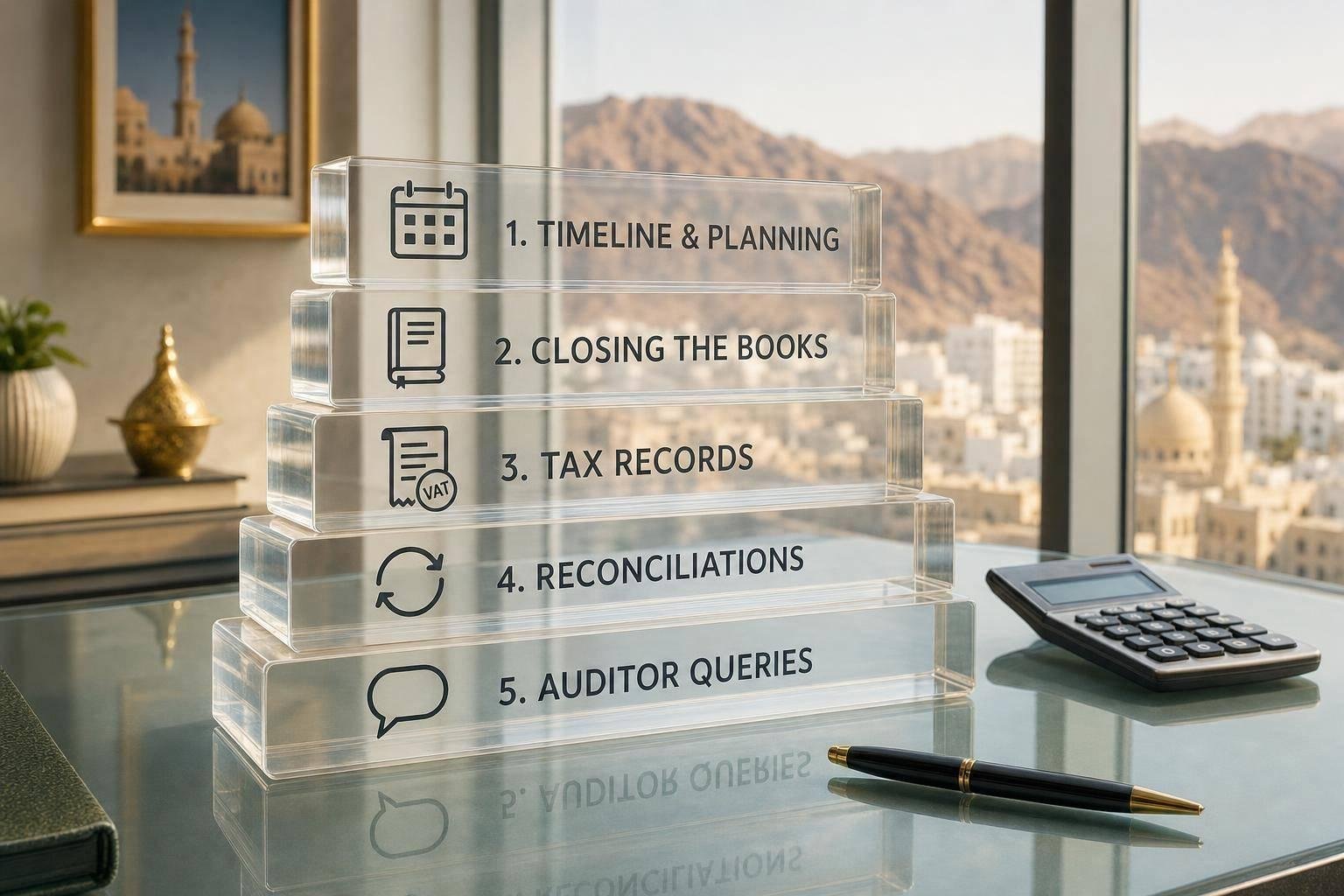
If I want an audit in Oman to go smoothly, I need to start before year-end filing dates hit. The article’s core message is simple: I should first confirm whether my company needs an audit, then set dates, close the books, reconcile every key balance, gather tax and payroll records, and answer auditor questions with matched evidence.
Here’s the short version:
- Companies with share capital above OMR 50,000 may need audited financial statements.
- Businesses under the 15% corporate income tax rate must file audited accounts with the annual tax return.
- Managers must prepare financial statements within 90 days of year-end.
- After that, the auditor has 60 days to issue the audit report.
- VAT returns are generally due within 30 days after the tax period ends.
- VAT records must usually be kept for 10 years, and up to 15 years for some real-estate records.
If I strip the process down, I’m doing four things:
- Confirm scope and deadlines
- Close the ledger and reconcile balances
- Build one clear evidence file
- Clear auditor queries and post agreed adjustments
The article also makes one point very clear: an audit problem often starts as a filing, reconciliation, or record-keeping problem. Missing bank support, VAT mismatches, old reconciling items, weak payroll backup, and unsupported journals are the issues most likely to slow sign-off.
So if I’m preparing for an Oman audit, I should treat it as a timed document exercise, not just an accounting task. That means one owner, one tracker, one file structure, and one final trial balance that ties to every schedule and source record.
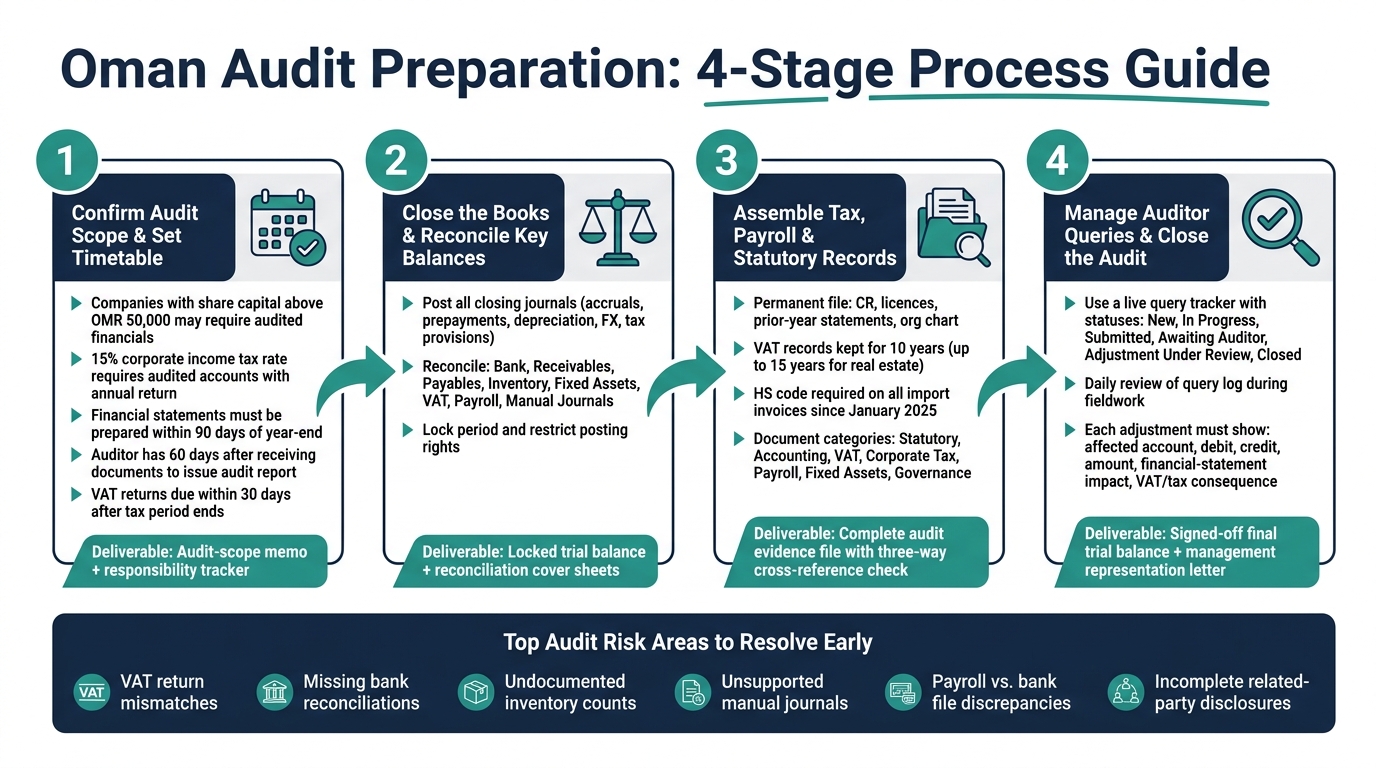
Oman Audit Preparation: 4-Stage Process Guide
Stage 1: Confirm the audit scope and set a timetable
Start with the scope and timetable. Those two decisions shape every document request that comes next. If the scope is vague, the audit drifts. If the timetable is loose, deadlines start slipping. Once the scope is agreed, move straight into a responsibility tracker.
Check statutory requirements and reporting basis
First, confirm the entity’s legal form, business activities, ownership, year-end, tax status, and any sector regulator rules. You also need to confirm whether the company must be audited because of its legal form, licence terms, finance arrangements, shareholder requirements, or regulator rules.
Put this into a one-page audit-scope memo. It should record the legal entity name, registration number, legal form, tax registrations, accounting framework, auditor appointment details, and any regulator or lender reporting requirements. That means the AGM resolution, licence evidence, and engagement letter should all be on file. The engagement agreement should also set out the reporting period, the entities and branches included, the reporting framework, audit deliverables, materiality, fieldwork dates, and management responsibilities.
Use IFRS unless a law, regulator, or group instruction says something else. Listed issuers are specifically required to prepare financial statements in line with IFRS Standards under the Capital Market Law. Record the basis in the audit planning file before the year-end close starts.
Deadlines vary by entity type, so don’t assume one size fits all. Under the Commercial Companies Law, managers must prepare financial statements within 90 days of the financial year-end. After receiving those documents, the auditor then has 60 days to prepare the audit report. VAT returns are generally due within 30 days after the end of the relevant tax period. Check the company’s exact filing duties with the Oman Tax Authority, the Ministry of Commerce, Industry and Investment Promotion, any sector regulator, and the appointed auditor.
Build an internal audit plan and responsibility tracker
Once the reporting basis is clear, work backwards from the earliest filing date. That could be the tax return, the AGM notice, or a lender reporting date. From there, set the key milestones: year-end close, inventory count, reconciliations, the first evidence pack, auditor fieldwork, management review, and final sign-off. Set separate dates for internal review and auditor review too. That buffer matters. Without it, year-end entries, reconciliations, and auditor follow-up can pile up at the worst possible moment.
Appoint one internal audit coordinator, usually the financial controller or finance manager, as the single point of contact. This person owns the document tracker, sends queries to the right people, and chases late items before they become a problem. Give each workstream to a named person, not just a department. Finance should own the trial balance and reconciliations. Tax should handle the income tax computation, VAT returns, and tax correspondence. Payroll and HR should manage employee records and end-of-service schedules. Operations should run the inventory count. The company secretary should keep the governance documents and licences.
A simple tracker works best. Use five columns:
- Request
- Owner
- Due date
- Status
- Notes
Keep status labels consistent: Not started, In progress, Submitted, Auditor follow-up, and Closed. Before you lock the timetable, check every statutory, tax, shareholder, and regulator deadline one more time. It’s a small step, but it can save a lot of last-minute pain.
| Planning item | Key question to answer | Evidence to retain |
|---|---|---|
| Reporting period | What exact dates are covered by the financial statements? | Commercial registration and system dates |
| Reporting basis | Is IFRS required, and are there group or regulator instructions? | Accounting policy memo, group reporting pack |
| Auditor appointment | Who is appointed and for which financial year? | AGM resolution, licence evidence, engagement letter |
| Tax deadline | When is the return due and are audited accounts required? | Tax registration, Tax Authority correspondence, filing calendar |
| AGM timetable | When must reports be circulated and approved? | Board and AGM calendar, notice requirements |
| Internal ownership | Who supplies each file and approves responses? | Responsibility tracker, escalation list |
After the plan is in place, close the books and reconcile the balances.
sbb-itb-55910af
Stage 2: Close the books and reconcile key balances
The next step is to get your accounting records ready for audit. A locked ledger, backed by support for each balance, cuts down audit questions. Use the timetable from Stage 1 to plan the close, then move straight into journals and reconciliations.
Complete year-end entries and finalise the trial balance
Post all approved closing journals, including accrued expenses, prepayments, provisions, depreciation, foreign-exchange revaluations, interest accruals, lease entries, tax provisions, and revenue or expense cut-off adjustments. Each journal should include the date, preparer, reviewer, accounts affected, amount, rationale, and supporting evidence.
For example, if you split advance payments between expense and prepayment, keep the invoice, proof of payment, and allocation support on file. If that backup is missing, the entry can quickly become a problem during audit.
Give extra attention to manual or late entries, along with round-sum or high-value entries. Run a separate report on these before closing the period. Any journal that affects revenue, related parties, provisions, tax, loan balances, leases, or retained earnings should have independent approval.
If an estimate changes – for instance, an expected credit-loss percentage moves from 2% to 4% – document the aged-debt analysis, past collection data, and the reason for the change. Also record whether the change is an estimate update or an error correction, and state the impact on the financial statements.
Once all journals are approved, run an updated trial balance and confirm that total debits equal total credits. Check suspense accounts, clearing accounts, unidentified cash, inactive vendor accounts, and unusual debit balances. Don’t just carry them forward without an explanation.
After review, lock the period and limit posting rights. Keep the pre-adjustment trial balance, the final adjusted trial balance, and the post-close trial balance. You should also keep a journal listing that shows all movements between those versions.
Once the adjusted trial balance is locked, reconcile each balance sheet line before sending the file to the auditor.
Reconcile cash, receivables, payables, inventory and fixed assets
Use the checklist below to test each balance sheet area.
| Area | Minimum audit evidence | Common gap |
|---|---|---|
| Bank | Bank statement, reconciliation, outstanding-item listing and reviewer sign-off | Old unreconciled items carried forward without explanation |
| Receivables | Aged ledger, customer statements, subsequent receipts and impairment assessment | Overdue balances unsupported by collection evidence |
| Payables | Aged ledger, supplier statements, subsequent payments and cut-off testing | Unrecorded liabilities or debit balances not investigated |
| Inventory | Count sheets, stock report, variance analysis and valuation support | Physical count not reconciled to the year-end ledger |
| Fixed assets | Register, invoices, approvals, depreciation schedule and disposal evidence | Register total does not agree to the general ledger |
| VAT | VAT return, output/input VAT reports, tax invoices and customs records | VAT control account does not reconcile to the filed return |
| Payroll | Payroll register, payment proof, liability reconciliation and employee schedules | Payroll expense agrees, but unpaid liabilities do not |
| Manual journals | Journal listing, calculation, evidence, explanation and approval | Late or unusual entries lack review evidence |
For inventory, use controlled count sheets and record damaged, obsolete, or consignment stock separately. Physical counts, stock records, and Bayan e-customs declarations should match.
For each reconciliation, prepare a cover sheet that shows:
- the trial-balance amount
- the supporting report
- reconciling items
- preparer
- reviewer
- date
- conclusion
Use consistent file names – for example, 2026-09-30_AR_AgedDebtors_OMR.xlsx – and keep an adjustment log that explains every difference.
Oman’s VAT Law says records, including tax invoices, accounting books, and customs documents, must be kept for at least 10 years after the end of the tax year in which the return is filed. That period can extend to 15 years for records linked to real estate. Keep the working papers under the same file structure and retention schedule, because the Oman Tax Authority expects the documents used to prepare a return to be available on request, not only the return itself.
With the books closed and balances reconciled, the next step is to assemble tax, payroll and statutory support files.
Stage 3: Assemble Oman tax, payroll and statutory records
Once the books are closed and the balances tie out, the next job is to gather the records behind those numbers. Put everything in one access-controlled repository, with folders for corporate information, accounting, VAT, corporate tax, payroll, fixed assets, contracts, banking, inventory and governance. Use the reconciled balances from Stage 2 as the file index, so each balance points to the evidence behind it.
Prepare accounting, VAT and corporate tax support files
Start with a permanent-information file. This should include your current Commercial Registration (CR), municipality licence and any sector-specific licence, Chamber of Commerce certificate, memorandum and articles of association, authorised-signatory details, shareholder and ownership records, prior-year audited financial statements, prior-year management-letter findings and the current organisation chart. Check that the legal entity name on sales invoices, bank accounts and loan agreements matches the CR exactly. If any licence or contract has expired, mark it clearly.
For accounting support, include the final trial balance, chart of accounts, general ledger, journal listing, year-end adjustment schedule, opening balances, bank statements and reconciliations, and sub-ledger reports for receivables, payables, inventory, provisions, accruals, loans, equity and intercompany balances. Each material journal should show the preparer, approver, date, accounts, amount and the evidence behind it.
VAT support needs more than the filed return. The Oman Tax Authority expects the records behind the VAT return, not just the return itself. That means preparing daily transaction records, master records, inventory records, output- and input-VAT reports, VAT control-account reconciliations, tax invoices issued and received, credit and debit notes, zero-rated and exempt-supply schedules, customs declarations, and import/export documents. Since January 2025, all import invoices must carry the 12-digit GCC Unified Tariff HS code, so review those details with care.
For corporate tax, include filed returns, the full tax computation, OTA notices or assessments, payment receipts and tax account statements. Add a profit-to-tax reconciliation so the path from accounting profit to taxable profit is clear.
Use the same retention schedule as the audit working papers. Also stick to one file-naming convention. It sounds basic, but messy file names slow everything down.
Compile payroll, fixed asset and governance documents
For payroll, gather monthly payroll registers, employee master data, employment contracts, salary and allowance breakdowns, approved payroll summaries, WPS bank transfer files, bank statements, leave records, overtime approvals, end-of-service calculations, bonus accruals and termination settlements. Then reconcile the annual payroll register to salary expense, payroll liabilities and bank payments.
A year-end leave provision, for example, should show the employee population, eligible days, salary basis, calculation method, approval and any reversal or settlement after year-end. Keep payroll files in a restricted-access folder, and give the auditor controlled extracts rather than full personnel records.
The fixed-asset file should include an asset register showing description, ID, location, custodian, supplier, cost, commissioning date, useful life, depreciation method, accumulated depreciation, net book value and disposal status. Attach purchase invoices, contracts, import or customs documents, payment evidence and physical verification reports. If an asset was disposed of, include authorisation evidence, sale or scrap documents, proceeds and the gain-or-loss calculation.
For governance, gather board and shareholder minutes, resolutions, dividend approvals, director or ownership changes, related-party approvals, financing agreements, covenants, guarantees, insurance policies, letters of credit and litigation correspondence. Flag all director, shareholder and group-company agreements for disclosure review.
| Document category | Key items |
|---|---|
| Statutory | CR, constitutive contract, municipality licence, Chamber of Commerce certificate, authorised-signatory details |
| Accounting | Trial balance, general ledger, journals, sub-ledger reports, bank statements and reconciliations, prior-year audited financial statements |
| VAT | VAT returns, daily and master records, output/input reports, tax invoices, customs declarations, zero-rated schedules |
| Corporate tax | Tax returns, computations, OTA correspondence, payment receipts, profit-to-tax reconciliation |
| Payroll | Payroll registers, WPS transfers, bank statements, leave and end-of-service calculations, employment contracts |
| Fixed assets | Asset register, purchase invoices, depreciation schedules, disposal evidence, physical verification reports |
| Governance | Board/shareholder minutes, financing agreements, insurance policies, related-party disclosures |
Before sending anything to the auditor, run a three-way check: trial balance to supporting schedules to source documents. Every balance-sheet account should have a reconciliation. VAT returns should agree to the VAT control accounts. Tax returns should agree to the computation and ledger. Payroll should agree to salary expense and bank payments. The fixed-asset register should agree to the general ledger.
It helps to track this in one simple status file with columns for:
- document requested
- evidence provided
- preparer
- reviewer
- date submitted
- outstanding issue
Then use a final checklist to confirm that the CR, licences, prior-year statements, ledger, invoices, contracts, bank statements, VAT workings, tax filings, payroll files, fixed-asset schedules and key legal agreements are complete and cross-referenced.
Once the audit file is ready, move on to auditor queries and clear any findings against the evidence pack.
Stage 4: Manage auditor queries, clear findings and close the audit
Once you’ve shared the audit file, the next job is simple in theory but messy in practice: deal with auditor queries fast and in a consistent way.
Use the existing audit co-ordinator as the single point of contact. Each area should also have a named owner and a backup, so nothing stalls when someone is away. Keep every response in the same controlled folder structure used for the audit file. Store read-only copies and log submission dates. And for every response, use the reconciled file pack from Stage 3 as the source.
Use a query tracker and respond with complete evidence
A live query tracker is the easiest way to keep fieldwork moving. It should include the query reference, audit area, auditor request, evidence required, internal owner, reviewer, date received, deadline, response date, status, folder or file reference, assumptions, proposed adjustment and final resolution.
Use clear statuses:
- New
- In progress
- Submitted
- Awaiting auditor
- Adjustment under review
- Closed
Review the log every day during busy fieldwork. It also helps to hold a short weekly check-in with finance and the auditor to clear old items. Don’t mark a query as closed until the auditor has accepted the evidence or confirmed the conclusion.
Once the tracker is live, each reply should link back to the same reference number, folder and final trial balance line. That way, every question, response and adjustment ties back to the signed-off trial balance.
When replying to a query, answer the question first. Then attach the evidence and a short explanation for any reconciling item. Each response should state the relevant general ledger account, period, amount, transaction population and final trial balance line.
For instance, if an auditor flags an OMR 18,400 payables difference, break it into clear reconciling items and attach the schedule. Don’t send unexplained spreadsheet differences. Don’t send several versions of the same schedule either. State assumptions plainly and show how the support agrees to the final trial balance.
Fix common Oman audit gaps before sign-off
Deal early with the issues that tend to slow sign-off in Oman. These often include VAT returns that don’t agree with the general ledger, missing or incomplete tax-invoice details, unreconciled bank accounts, unexplained intercompany balances, undocumented inventory counts, payroll totals that don’t agree with the payroll system or bank file, fixed-asset register differences, unsupported manual journals and incomplete related-party disclosures.
For each gap, record:
- the root cause
- the financial or compliance impact
- the corrective action
- the responsible person
- the target date
- the evidence of completion
If you call a difference timing-related, back it up with the source document and the clearing date. Without that, it’s just a label.
For proposed audit adjustments, make sure each one shows the affected account, debit, credit, amount, financial-statement impact and any VAT or tax consequence before you accept it. Keep an adjustment schedule with columns for proposed, accepted, rejected, posted and carried forward. No entry should go into the final trial balance without finance director approval.
Keep audit adjustments, internal-control deficiencies and recommendations separate. For each management-letter point, document the issue, cause, risk, action, accountable owner, due date and evidence needed for closure.
If a prior finding is repeated – say, unsupported manual journals – don’t just recycle the old response. Show the revised procedure, the implementation date and a sample of journals tested. If management accepts a residual risk, record the reason and the approval instead of leaving the point hanging.
After the final query is cleared, move into formal close-out. Use a close-out checklist to confirm that the final trial balance agrees to the financial statements, accepted audit adjustments are posted, reconciliations are complete, subsequent events and related-party disclosures are reviewed, VAT and income-tax support ties to the accounts, management-letter responses are approved, and all queries are either closed or formally outstanding.
Then confirm the reporting basis, accounting policies, comparative figures, authorisation date and signatories. After that, obtain written management representation once the underlying schedules have been reviewed, then file the final evidence pack with version control.
Need help with your statutory audit? AOWJ’s audit and assurance services cover it from start to finish. Contact us for a consultation and a clear quote.
FAQs
Do all companies in Oman need an audit?
No. Not all companies in Oman need an audit.
A statutory audit is required for companies with share capital above OMR 50,000 and for companies that meet certain size thresholds. That said, all businesses are still expected to keep properly prepared financial accounts when filing taxes with the Oman Tax Authority.
What documents should I prepare first for an audit?
Start with your financial statements. You’ll need these for statutory audits and tax filings in Oman.
Then sort the accounting records that back them up. Those records should match IFRS and Oman Tax Authority rules, including VAT and tax support files, payroll records, and fixed asset schedules.
What usually delays audit sign-off in Oman?
The available sources don’t say what usually holds up audit sign-off in Oman. What they do confirm is that companies with share capital above OMR 50,000, along with companies that meet certain size thresholds, must go through statutory audits.
That said, these sources stop there. They don’t spell out the day-to-day or process-related reasons why those audits may take longer to finish.