


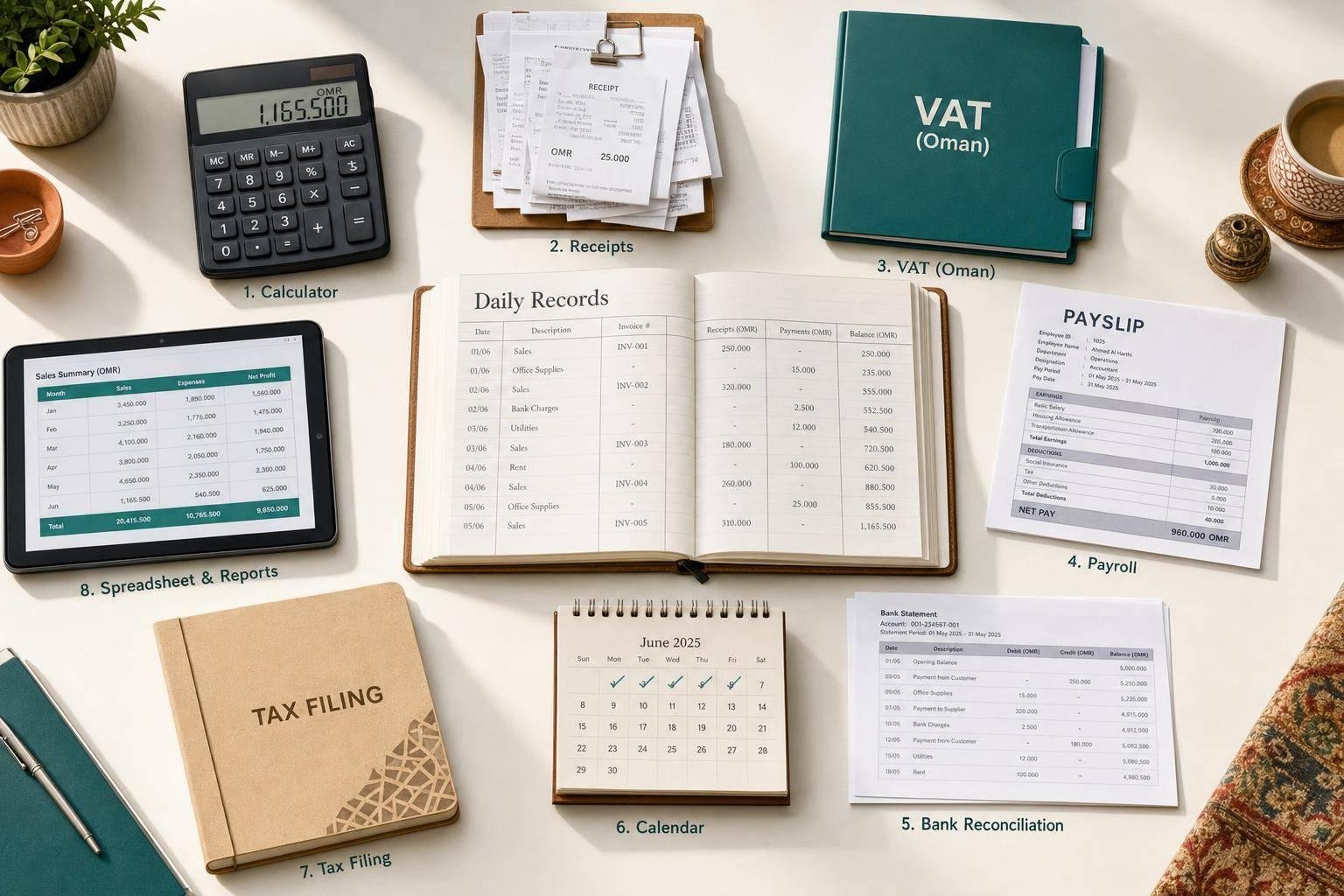
If I run an SME in Oman, I can’t treat bookkeeping as a year-end job. VAT is 5%, VAT returns are usually due within 30 days after each tax period, corporate tax returns are due within 4 months of year-end, and many records must be kept for 10 years.
Here’s the short version: I need to record transactions daily, keep cash and bank records up to date, track who owes me and who I owe, store every invoice and backup document, reconcile bank accounts, keep payroll files in order, prepare monthly accounts, and make sure the books support VAT, corporate tax, and audit checks.
At a glance, the article covers these 8 basics:
- Daily transaction recording
- Cash book and bank book upkeep
- Receivables and payables tracking
- Invoice and document filing
- Bank reconciliations
- Payroll record-keeping
- Basic financial statements
- VAT, corporate tax, and audit readiness
What stands out is simple: good bookkeeping is about control. It helps me see cash flow, late payments, unpaid bills, payroll costs, and VAT positions before they turn into a problem. The article also points to a few hard rules worth remembering:
- VAT rate: 5%
- VAT return deadline: within 30 days
- Corporate tax return deadline: within 4 months of year-end
- Record retention: usually 10 years
- Real-estate VAT records: up to 15 years
- Employee files: at least 1 year after employment ends
A few points matter most in practice:
- Enter transactions in date order and without gaps
- Split net, VAT, and total amounts clearly
- Match invoices, payments, and bank movements to source records
- Review receivables and payables at least monthly
- Reconcile each bank account separately
- Keep payroll records linked to contracts, attendance, deductions, and WPS proof
- Close the books monthly and trace every figure back to support
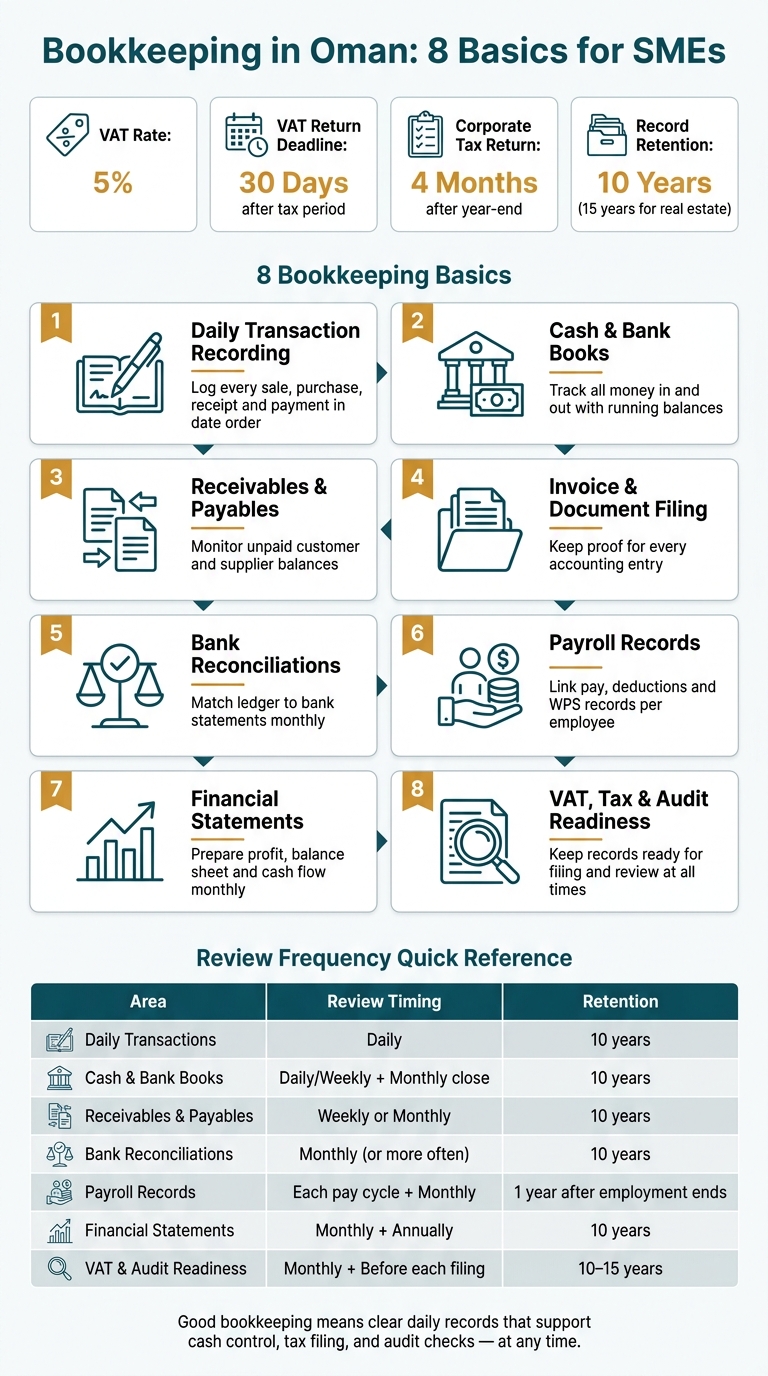
Bookkeeping Basics for Oman SMEs: 8 Key Areas at a Glance
Bookkeeping basics for small business | Small Business Advice
sbb-itb-55910af
Quick comparison
| Area | Main job | Review timing | Retention |
|---|---|---|---|
| Daily transactions | Record sales, purchases, receipts, payments | Daily | 10 years |
| Cash and bank books | Track money in and out | Daily or weekly; monthly close | 10 years |
| Receivables and payables | Track unpaid customer and supplier balances | Weekly or monthly | 10 years |
| Invoices and documents | Keep proof for each entry | As issued/received; monthly check | 10 years |
| Bank reconciliations | Match books to bank statements | Monthly or more often | 10 years |
| Payroll records | Keep pay, deduction, and WPS records | Each pay cycle; monthly review | 1 year after employment ends, or longer if needed |
| Financial statements | Prepare profit, balance sheet, and cash flow reports | Monthly and annually | 10 years |
| Tax and audit readiness | Make records ready for filing and review | Monthly, before VAT filing, and year-end | 10 years; 15 years for some real-estate records |
So if I had to sum the article up in one line, it would be this: bookkeeping in Oman means keeping clear daily records that can support cash control, tax filing, and audit checks at any time.
1. Record Daily Transactions
This is where bookkeeping starts: record every transaction in date order.
Your daily transaction record should include each sale, purchase, receipt, payment, refund, expense, transfer, asset purchase, import and export, all logged in chronological order with a reference for each entry. Oman’s VAT guidance says taxable transactions must be recorded daily, in sequence, with supporting documents that let you verify each entry.
Each record should show:
- Date
- Reference number
- Customer or supplier
- Short description
- Net amount in OMR
- VAT
- Total
- Payment method
- Account code
- Source document
For example, if invoice INV-1042 was issued on 24/09/2026 for branding services, the entry would show Al Noor Trading, OMR 500.000 net, OMR 25.000 VAT and OMR 525.000 total, linked to the quotation, invoice and proof of delivery.
The best habit is simple: enter transactions on the same day they happen. Then review the record daily and check it each week for gaps, duplicates and VAT errors. At a minimum, make sure:
- Invoice numbers run in sequence with no gaps
- Every bank and cash movement has a clear explanation
- VAT treatment is correct and backed by documents
Oman’s VAT Law also says relevant transactions must be recorded on time.
You should also tag each entry with a ledger category, such as sales, cost of goods sold, rent, utilities, wages or bank charges. That makes it much easier to move sales, costs and overheads into later reports. Alongside that, mark each transaction by VAT treatment: standard-rated, zero-rated, exempt or out of scope.
If your business imports or exports, link the daily record to customs documents and inventory records as well. Those records support your VAT calculations.
Keep records and supporting documents for at least 10 years. For real-estate records, keep them for up to 15 years. Whether you use a controlled spreadsheet or accounting software, the record needs to be readable, backed up and easy to trace from each entry to its source document.
Once the daily record is complete, move the totals into your cash and bank books.
2. Maintain Cash and Bank Books
Once you enter daily transactions, they should flow into two main ledgers: your cash book and your bank book.
They do different jobs.
The cash book records every movement of physical cash. That includes cash sales, petty-cash purchases, staff advances, customer refunds, delivery costs, and owner drawings. The bank book records transactions through each bank account, such as deposits, withdrawals, cheque payments, bank charges, and transfers.
If you use OMR and foreign-currency accounts, keep a separate bank ledger for each account. And if money moves between accounts, record it as a transfer between those accounts, not as income or expense. That small detail matters more than many people think.
Each entry should include:
- the date
- the payer or payee
- a clear description
- a reference number
- the amount
- VAT treatment, where needed
- the running balance
For bank entries, add the bank reference and posting date where needed. Each entry should also link back to its source document so the VAT treatment can be checked later. That could be a receipt, tax invoice, payment voucher, deposit slip, or electronic transfer confirmation.
Update the cash book every time cash moves. Then count physical cash at the end of each business day. For bank books, daily updates are best if you have a high number of transactions. A weekly update may be enough for a low-volume SME, as long as nothing is missed.
What you should not do is leave everything until month-end.
When entries are delayed, it becomes much harder to spot missing receipts, duplicate payments, or VAT mistakes while there is still time to fix them. Even if transaction volume is low, close and review both books every month.
Petty cash needs extra control. Set a documented float, name a custodian, and set an approval limit. Use pre-numbered vouchers for every payment. At the end of each day, the custodian should confirm that opening cash + receipts − payments = expected closing balance. If there is any difference, investigate it and document the result.
Before closing the books at month-end, run through this quick check:
- All cash receipts and payments are entered in date order, with no gaps, and the physical cash count matches the cash-book balance, or any differences are documented
- Every active bank account has a completed reconciliation, with all charges, fees, interest, direct debits, and transfers posted, and any outstanding cheques, deposits in transit, or failed payments listed and followed up
- VAT categories and amounts match the underlying invoices
- Cash and bank ledgers match the general ledger and trial balance
Once cash and bank balances are under control, move on to receivables and payables.
3. Track Receivables and Payables
After your cash book and bank book, the next job is to track every unpaid customer balance and supplier bill in separate ledgers. This matters for two reasons: getting paid on time and keeping your VAT records right. Each balance should tie back to the invoice and the supporting paperwork.
For each customer or supplier, record:
- invoice number
- invoice date
- registered customer or supplier name
- due date
- net amount
- VAT
- total amount
- payment terms
- adjustments
- running balance
Keep net, VAT and total as separate figures. That makes customer and supplier balances much easier to reconcile to the VAT return.
An ageing schedule helps you see unpaid invoices at a glance. Group them by how long they’ve been outstanding: current, 1–30 days overdue, 31–60 days, 61–90 days, and over 90 days. It’s a simple tool, but it does a lot of heavy lifting. You can use it to chase late-paying customers and plan supplier payments before the due date.
Update the ledgers whenever you issue or receive an invoice, credit note, receipt or payment. Then do a formal review at least once a month – or every week if you handle frequent transactions, have tight cash flow, or are dealing with large overdue balances. At month-end, reconcile total customer balances to trade receivables and total supplier balances to trade payables in the trial balance. If something doesn’t match, check it there and then instead of rolling the difference into the next period.
Before you approve a supplier payment, match the invoice against the purchase order and delivery note, or other proof that the service was completed. For customer invoices, check the registered legal name, VAT details, invoice sequence, supply date and VAT treatment before sending them out. Store each balance with the related invoice, credit note, delivery note and proof of payment in a file you can pull up without a fuss. Once balances are current, keep the source invoices and supporting evidence together in one place.
4. File Invoices and Supporting Documents
File each invoice with the records that prove the transaction from approval through to payment. For a stock purchase of OMR 1,050.000, for example, the file might include the approved purchase order, the supplier’s tax invoice, the delivery note, the goods-received note and the bank-transfer confirmation, all linked under one reference such as 2026/09/Purchases/INV-1048. That single file then becomes the source for later VAT checks and bank reconciliations.
Keep the records that support each entry. This includes daily transaction logs, general ledger records, stock records, import and export papers, customs documents and invoices issued or received.
Keep VAT, accounting and customs records for 10 years. Keep real-estate records for 15 years.
Organise files by financial year, month, document type and transaction reference when issued or received. A weekly completeness check can help spot missing invoices, gaps in the sequence or unmatched payments before they turn into VAT filing mistakes. Electronic records should be searchable, backed up in two separate locations and locked against unauthorised changes. Paper originals should be scanned and indexed to the related accounting entry. Once the files are complete, match them against the cash and bank books.
Use this quick checklist to confirm your invoice files are in order:
| Check | What to verify |
|---|---|
| Sequential numbering | No gaps or duplicates in invoice numbers; any exceptions investigated |
| Complete supplier and customer details | Supplier and customer details, dates, descriptions, values and VAT treatment are complete |
| VAT treatment | Taxable value, VAT rate and VAT amount shown clearly on every invoice |
| Supporting documents | Supporting documents linked to each invoice |
| Credit notes and corrections | Linked to the original invoice; the original retained alongside the replacement |
| Import and export files | Customs declaration, shipping documents and zero-rated evidence attached where relevant |
| Access and backup | Files searchable, access-controlled and backed up in two separate locations |
Use these files to match each invoice, receipt and payment against the bank book.
5. Reconcile Bank Accounts
Use the bank book from the previous section to reconcile each account against the bank statement. Put simply, bank reconciliation compares your ledger with the bank statement. It helps you spot missing entries, duplicate postings, bank charges, direct debits, outstanding items and posting errors, so your cash balance is dependable for VAT, corporate tax and reporting.
Reconcile every bank account separately. That includes operating accounts, payroll accounts, foreign-currency accounts and any merchant or payment-service accounts. At a minimum, do this monthly and complete it as soon as the statement period ends. If your business handles a lot of transactions, weekly reconciliation makes more sense. If you’re dealing with heavy cash activity, such as in retail, food and beverage, or hospitality, daily checks are often the safer route.
Each time you reconcile, follow the same checks in the same order. Start by confirming that the opening balance matches the prior month’s approved reconciliation. Then match every deposit, withdrawal, transfer, card settlement, bank charge, interest credit, cheque and direct debit against the ledger.
Post any bank-originated items that are not yet in the books, such as charges, transfer fees and direct debits. Keep genuine timing differences on a separate list with the date, amount, explanation and expected clearance date. For example, a deposit of OMR 1,250.000 recorded on 30 September but not cleared until the October statement is a deposit in transit. Each reconciling item should tie back to the invoice, voucher or transfer confirmation filed earlier. If anything is still outstanding after 30 days, flag it and keep reviewing it until it’s cleared up.
The reconciliation file should include:
- The bank statement
- The cash book or bank ledger
- The reconciliation report showing both balances and each reconciling item
- Supporting documents for every difference
- Preparer and reviewer sign-off
Keep transaction posting separate from reconciliation. That split makes it easier to spot unauthorised transfers, payments with no invoice behind them and duplicate entries. Store the full reconciliation package with the rest of your accounting records.
| Check | Evidence to retain |
|---|---|
| Opening balance agrees with prior month’s reconciliation | Prior approved reconciliation report |
| Closing balance agrees with bank statement | PDF or downloaded bank statement |
| Deposits in transit are genuine and subsequently credited | Deposit slip and later bank entry |
| Uncleared payments are valid and still outstanding | Payment approval, invoice and later clearance |
| Bank charges and interest are posted | Bank statement and journal entry |
| Transfers between accounts are complete | Both account statements and transfer reference |
| Unusual items are investigated | Invoice, receipt, contract or written explanation |
| Reconciliation is reviewed and signed off | Preparer and reviewer sign-off |
Use the reconciled bank balance as the starting point for payroll postings and month-end close.
6. Organise Payroll Records
Payroll records tie wages, deductions and employer costs back to cash flow, tax and audit checks. Once bank accounts are reconciled, payroll becomes the next place to tighten control.
Keep one file for each employee. It should include identity details, contract terms, leave, discipline, performance and termination records. Under Oman’s Labour Law (Royal Decree 53/2023), each file must be kept for at least one year after employment ends. If tax or audit rules require a longer period, keep payroll records for longer.
Next, turn every pay run into a monthly payroll register. Give each employee a separate line that shows the payroll month, employee file number, nationality, basic salary, allowances, overtime, gross pay, deductions, employer contributions, net pay, payment date and approval. For instance, if an employee has OMR 450 basic pay, OMR 50 housing and OMR 20 overtime, the register should show OMR 520 gross pay, backed up by the contract, attendance record and approval.
Pay wages through WPS and keep the upload confirmation, transfer proof and any rejected-payment notices. Under Ministerial Decision No. 729/2024, wages must be transferred within three days of the end of the wage-entitlement period.
Also keep SPF registration records, monthly calculations, invoices, receipts and adjustment records. Each month, reconcile the payroll deduction and employer contribution to the SPF bill as one payroll control step. It’s a simple habit, but it stops small errors from snowballing.
A short review routine helps keep records tidy and up to date:
- Each pay cycle: check starters, leavers, attendance, overtime, leave adjustments, bank details and WPS status before payment is released.
- Monthly: reconcile the payroll register to the WPS confirmation, SPF bill and payroll-control account.
- At least annually: review employee master data, contracts, salary changes, leave balances, contribution classifications, termination calculations, access permissions and document completeness.
Use these records to post payroll correctly and carry the balances into the month-end accounts.
7. Prepare Basic Financial Statements
Once the ledgers are up to date, turn them into three core reports: the statement of profit or loss, the statement of financial position, and a cash-flow summary. These reports need to match the ledgers, bank accounts, receivables, payables, and payroll records already in place. In most cases, management accounts should be prepared monthly. Quarterly reporting only makes sense when transaction volumes are low. A sensible routine is to close the books by the fifth working day of each month and issue the profit or loss report by the tenth working day. Prepare the statements under IFRS in OMR, unless the Tax Authority allows a different basis.
Before closing the period, post accruals, prepayments, depreciation, inventory movements, bad-debt provisions, loan interest, and payroll liabilities. These adjustments matter because they stop profit and assets from being overstated. Once they’re in the ledger, the figures are ready for review and sign-off.
The final statements and supporting schedules should also back up VAT, corporate tax, and audit filings. That link matters. If a figure appears in the accounts, you should be able to trace it back without any guesswork.
Every number in the statements should tie back to a schedule or reconciliation. Keep a period-end file with the trial balance, ledger detail, bank reconciliations, aged receivables and payables, fixed-asset register, inventory count, depreciation schedule, payroll summary, tax workings, and explanations for material variances. Archive the signed statements and working papers securely.
| Report | Main question answered | Suggested frequency |
|---|---|---|
| Statement of profit or loss | Did the business make a profit? | Monthly and annually |
| Statement of financial position | What does the business own and owe? | Monthly and annually |
| Cash-flow summary | Where did cash come from and go? | Monthly |
8. Keep Books Ready for VAT, Corporate Tax and Audit
Once your day-to-day bookkeeping is in order, the next job is making sure those records are ready for tax and audit. Financial statements only help if the records behind them can stand up to scrutiny. In Oman, the Tax Authority expects a clear trail from source documents through to the figures reported for VAT and corporate tax. If you run a trading business, your invoices should also show the correct 12-digit GCC Unified Tariff HS code.
You also need to keep records for the right length of time. VAT, corporate tax and customs records should be kept for 10 years. Real-estate records should be kept for 15 years.
This isn’t something to leave until filing season. Check your records each month, before every VAT return, and again at year-end. On a monthly basis, reconcile VAT control accounts and other key balances. Before each VAT filing, make sure all sales and purchases for the period have been recorded, VAT rates and tax codes have been used the same way throughout, credit notes and returned goods have been handled properly, and the return matches the VAT control account. VAT returns and payments are generally due within 30 days after the end of the tax period. At year-end, review record retention, access to files, accounting policies, and whether a statutory audit applies.
Use the checklist below to catch gaps before filing dates.
| Area | What to confirm |
|---|---|
| Transactions | All entries recorded; invoices numbered sequentially; sales and purchase invoices complete |
| VAT | Taxable, exempt and zero-rated supplies separated; VAT treatment documented |
| Imports/exports | Customs records, HS codes and cross-border evidence filed |
| Corporate tax | Tax computation reconciles to accounting profit; non-deductible items identified |
| Payroll | WPS records and PASI contributions agree to the ledger |
| Assets | Fixed-asset register and depreciation schedule updated |
| Returns | Submitted VAT and corporate tax returns agree to the books; payment confirmations saved |
| Retention | Records backed up and retrievable; 10-year rule applied, with 15 years for real-estate records where relevant |
It also helps to keep a dedicated audit file. That file should contain the trial balance, general ledger, bank reconciliations, bank statements, sales and purchase listings, inventory count sheets, payroll reports, loan confirmations, contracts, tax computations and VAT reconciliations. Keep it up to date, and check statutory audit requirements with an Omani accountant or auditor. Keep these files current for the quick reference table below.
Quick Record-Keeping Reference Table
Use this table as a quick month-end checklist for the eight bookkeeping basics above. It sums up each one, why it matters, how often to review it, and how long to keep the records.
Keep most records for 10 years from the end of the relevant accounting or tax period. Keep real-estate-related VAT records for up to 15 years.
| Bookkeeping Basic | Main Purpose | VAT or Tax Relevance | Typical Review Frequency | Retention Period |
|---|---|---|---|---|
| 1. Record Daily Transactions | Creates a chronological record of sales, purchases, receipts, payments and adjustments | Supports VAT-return figures, taxable or exempt classification and the audit trail back to source records. | Daily posting; weekly completeness check | 10 years after the relevant accounting or tax period |
| 2. Maintain Cash and Bank Books | Shows money received and paid, along with the running balance of each cash account and movement in every business bank account | Supports payment proof, expense claims and VAT reconciliation | Daily or whenever money moves; monthly close | 10 years after the relevant accounting or tax period |
| 3. Track Receivables and Payables | Shows amounts owed by customers and to suppliers, with due dates and ageing | Links sales and purchase invoices to VAT treatment and supports income, expense and liability calculations for corporate tax | Weekly monitoring; formal month-end ageing review | 10 years after the relevant accounting or tax period |
| 4. File Invoices and Supporting Documents | Keeps the evidence behind each accounting entry | Supports VAT compliance and customs evidence | File as received or issued; monthly completeness check | 10 years; up to 15 years for real-estate-related VAT records |
| 5. Reconcile Bank Accounts | Compares the accounting ledger with bank statements and explains differences | Helps detect omitted income, duplicated expenses and unsupported payments before VAT or tax filing | Monthly; more frequently for high-volume businesses | 10 years after the relevant accounting or tax period |
| 6. Organise Payroll Records | Documents gross pay, deductions, net pay, payroll journals and bank-transfer evidence | Supports payroll expense postings, corporate tax calculations and audit evidence for staff costs | Each pay period; month-end payroll-to-ledger review | At least 1 year after employment ends; keep longer where tax or audit rules require |
| 7. Prepare Basic Financial Statements | Summarises profit or loss, financial position and cash flow information | Provides a controlled basis for corporate tax computations, management review and audit work | Monthly management accounts; annual final statements | 10 years after the relevant accounting period |
| 8. Keep Books Ready for VAT, Corporate Tax and Audit | Keeps returns and reported figures backed by complete records | Supports VAT, corporate tax and audit review. | Before each VAT return; monthly control-account review; annual audit-readiness review | 10 years by default; up to 15 years for real-estate-related VAT records |
Use one file-naming format across all records: financial year-month-document type-supplier/customer-reference.
For example:
2026-09-PurchaseInvoice-SupplierName-INV1048
Conclusion
Accurate books come from routine. Record transactions as they happen, keep a supporting document for every entry, reconcile cash and bank balances, and close the books on a regular schedule. Those habits make month-end close faster and tax filing safer.
Compliance should sit inside day-to-day bookkeeping, not be left until year-end. The same records you use to run the business also support VAT, corporation tax and audit work. The next step is a disciplined pre-filing review.
Before filing:
- Confirm all invoices are posted
- Reconcile cash and bank balances
- Review receivables, payables and accruals
- Verify VAT coding
- Document every adjustment clearly
Don’t leave unexplained manual entries in the ledger. If your books don’t produce a clear audit trail, get specialist support before the next filing deadline.
Need help with your bookkeeping and year-end accounts? AOWJ’s accounting, audit and assurance services cover it from start to finish. Contact us for a consultation and a clear quote.
FAQs
What bookkeeping software suits an SME in Oman?
For SMEs in Oman, Odoo ERP is a strong choice for managing financial records, payroll and day-to-day operations.
A system like Odoo helps you stay in line with Oman Tax Authority rules and IFRS standards. It brings bookkeeping, payroll and tax work into one place, which makes it easier to keep records accurate and prepare audit-ready financial statements.
How can I spot bookkeeping errors before filing VAT?
Before you file your quarterly VAT return, make sure your records are fully reconciled and line up with Oman Tax Authority rules.
- Reconcile your bank accounts against your cash book and bank book
- Check that invoices and supporting documents match the transactions you’ve recorded
- Prepare your accounts in line with IFRS so your data stays accurate
When should I outsource bookkeeping support?
Consider outsourcing your bookkeeping when you need your financial records to stay in line with Oman Tax Authority rules and IFRS standards.
This can be especially helpful for VAT registration and filing, corporate tax compliance, and the preparation of audit-grade financial statements. It also helps keep your books complete and up to date, so you can spend more time on growth and day-to-day operations.